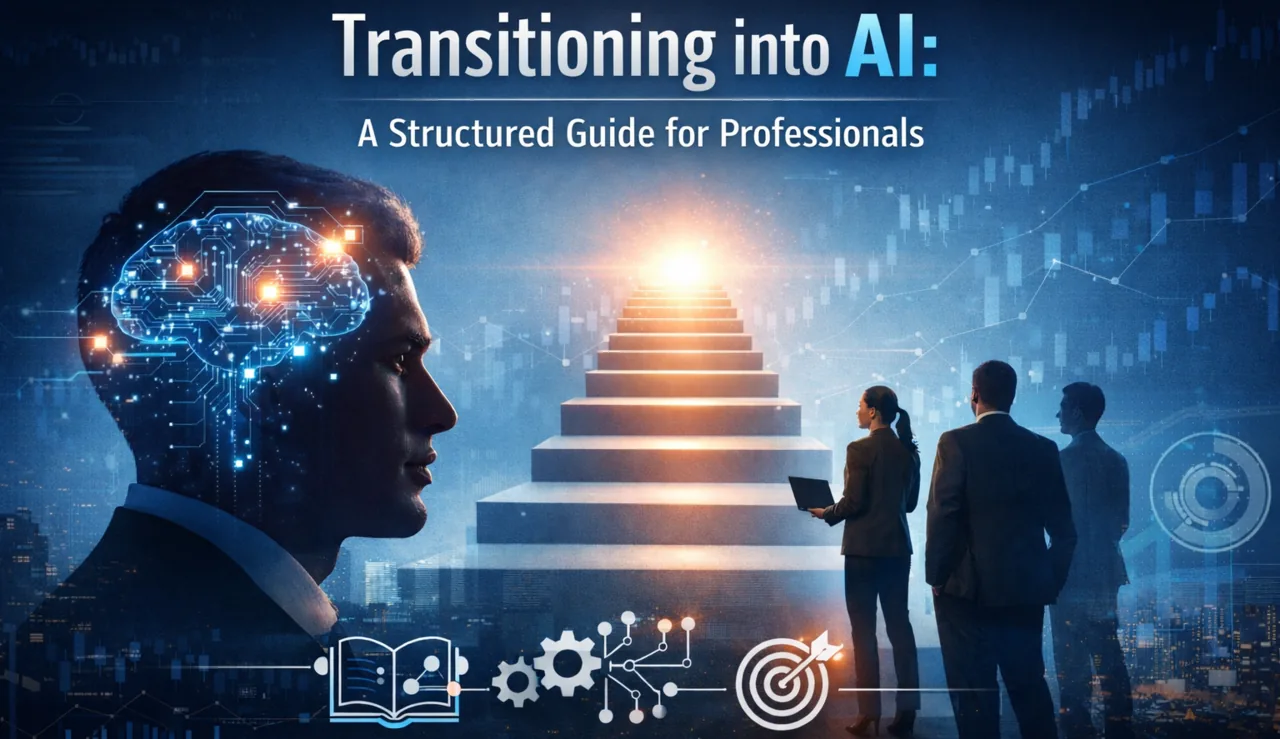
Transitioning into AI: A Structured Guide for Professionals
Moving into AI isn't just a skill upgrade — it's a mindset shift. Here's how to navigate the transition with clarity, strategy, and confidence.
Every week I speak with professionals who want to move into AI — software engineers, data analysts, business consultants, and domain experts from healthcare, finance, and logistics. They're smart, motivated, and technically capable. Yet most of them don't know where to start, what to prioritise, or how to position themselves credibly in a field that moves fast and rewards substance over buzzwords.
After years of consulting, teaching, and mentoring professionals across this exact transition, here is the honest, structured guide I wish had existed when I was building my own AI practice.
Why Most Transitions Fail (And It's Not the Skills)
The biggest misconception is that transitioning into AI is primarily a technical problem — that if you learn Python, complete a machine learning course, or earn a certification, the rest will follow. It won't.
The professionals who struggle most are those who learn the tools but never develop the thinking. They can run a model, but they can't frame a business problem. They understand gradient descent, but they can't explain why a model's output matters to a stakeholder. They acquire skills in isolation, without a coherent narrative about who they are and the value they bring.
AI is, at its core, an applied discipline. The technical capability is a prerequisite, not a differentiator. The differentiator is how you think.
Step 1: Anchor on a Problem Domain, Not a Tool
Before you write a single line of code or enrol in another course, answer this question: What problems do I understand deeply enough to solve?
Your existing domain expertise is not a liability to shed — it is your greatest asset. A healthcare professional who understands clinical workflows will build better health AI than a computer scientist who has only read about hospitals. A financial analyst who understands credit risk will design better fraud detection systems than someone who knows the algorithms but not the domain.
The professionals who transition successfully do so by combining domain depth with AI capability — not by abandoning what they know to start from zero.
Practical exercise: Write down three problems in your current or previous domain that are high-stakes, repetitive, or data-rich. These are your AI opportunities. These become the anchor for your learning journey and your portfolio.
Step 2: Build a Structured Learning Path (Not a Random Course Collection)
LinkedIn Learning, Coursera, Udemy, YouTube — the content exists. The problem isn't access. The problem is structure. Most people accumulate courses without a coherent skill architecture.
Here is a three-layer framework I use with mentees:
Layer 1 — Foundations (non-negotiable): Statistics and probability, linear algebra basics, Python programming, SQL. You don't need to be expert-level, but you need to be fluent. These are not optional.
Layer 2 — Core ML/AI: Supervised and unsupervised learning, model evaluation, feature engineering, and one deep-dive specialisation relevant to your target domain (NLP, computer vision, time series, recommendation systems). Stick to one specialisation — breadth without depth signals a generalist who dabbles.
Layer 3 — Applied and Emerging: Generative AI, large language models, agentic systems, MLOps, and responsible AI principles. This is where the market is heading, and where your differentiation can be sharpest if you've built the foundation first.
The mistake is jumping to Layer 3 before Layer 1 is solid. Foundation gaps show immediately in technical interviews and on real projects.
Step 3: Build Projects That Solve Real Problems
Your portfolio is your proof of work. And the most compelling portfolios I've reviewed share one characteristic: they solve a specific, real problem — not a textbook exercise.
"I built a sentiment analysis classifier on the IMDB dataset" is a learning exercise. "I built a complaint classification system that reduced customer service escalation time by 40% for a mid-sized e-commerce business" is a project.
The difference is not the complexity of the algorithm. The difference is the problem framing, the context, and the measurable outcome. Even if your project is personal, simulate the professional context. Define the problem statement. Identify the stakeholder. Define what "done" looks like and what success would mean.
Aim for two to three strong projects, each in a different area of the stack (data engineering, modelling, deployment) and ideally in your target domain.
Step 4: Reframe Your Professional Narrative
Technical skills get you past a filter. Your narrative gets you hired.
Most career changers write CVs and LinkedIn profiles that read like learning journals: "Currently upskilling in machine learning. Completed X certification. Building projects in Y." This positions you as a student, not a practitioner.
Instead, lead with the intersection: I bring [domain expertise] to AI problems in [target area], and here is what that looks like in practice.
Every experience on your CV should be reframed through the lens of your AI positioning. The business analyst who worked with customer data for five years is not just a business analyst — they are someone who understands data at the point of business impact, which is exactly what most AI projects lack.
Your summary should answer three questions: What do you bring? Where do you apply it? What have you done that proves it?
Step 5: Prepare Specifically for AI Interviews
AI and data science interviews are structured differently from standard software engineering interviews. The technical component typically covers:
- Conceptual understanding of ML algorithms (not just implementation)
- Case studies: how would you approach problem X?
- Statistics and probability questions
- Coding challenges (Python, SQL)
- System design for ML pipelines
- Portfolio walkthrough and project deep-dives
The case study component is where most candidates underperform — not because they lack knowledge, but because they lack a structured thinking framework. The best AI practitioners I know approach every problem the same way: clarify the goal, understand the data, define success, choose approach, iterate and validate, communicate clearly.
Practise this framework with real problems, not theoretical ones. Use your portfolio projects as the foundation for your case study rehearsals.
Step 6: Engage With the Community Strategically
Visibility matters. And you don't need 10,000 followers to build a meaningful professional presence. You need to be consistently present in the spaces where your target audience is.
Write about what you are learning and building — not to perform expertise you don't have, but to document genuine insights. A short LinkedIn post about a challenge you faced on a project and how you solved it is more credible than a polished thought leadership piece written from a distance.
Engage with practitioners in your target domain. Comment thoughtfully on their posts. Attend industry events, webinars, and meetups. These interactions build real relationships that often matter more than applications to job postings.
The Honest Timeline
I am often asked: how long does this take? The honest answer is that it depends on your starting point, the time you can invest, and how deliberately you approach each step. For most professionals with strong domain expertise and moderate technical background, a focused twelve to eighteen months is a realistic window to be genuinely competitive for mid-level AI roles.
The professionals who move fastest are those who commit to the process, build in public, seek feedback continuously, and resist the temptation to keep learning without building.
Final Thought
The AI field needs people who bring more than technical skill — it needs practitioners who understand domains, who can reason under uncertainty, who can communicate to non-technical stakeholders, and who take the responsibility of building consequential systems seriously.
If you are making this transition, you are not starting from zero. You are bringing a perspective that pure technologists often lack. The key is to structure your transition deliberately, build evidence of your capability, and position yourself as someone who thinks well — because in AI, how you think is the differentiator.
— Dr. Nabanita Sinha