What GraphRAG Is—and Is Not
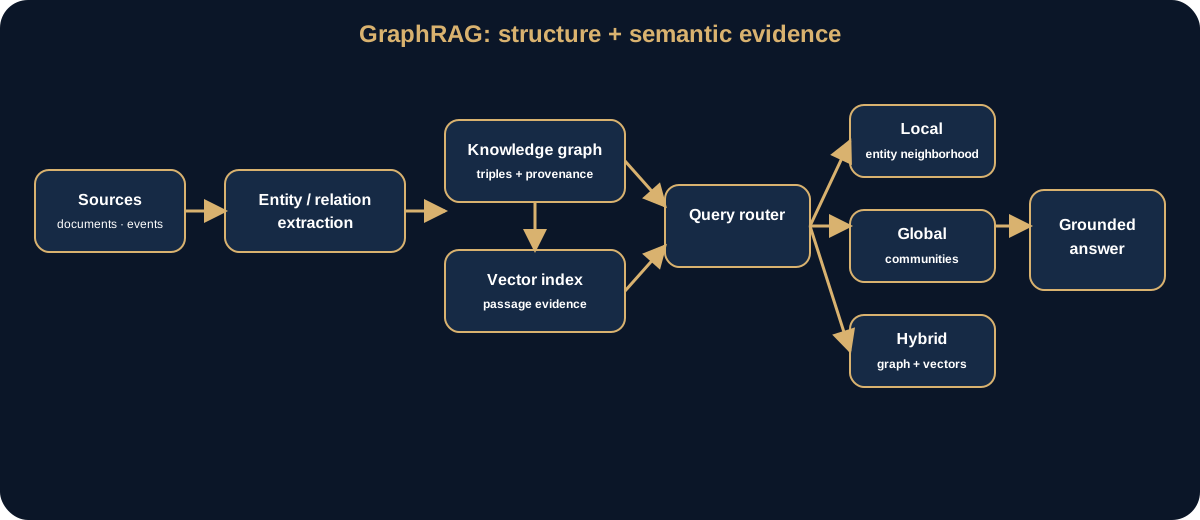
GraphRAG is a retrieval-augmented generation architecture in which a knowledge graph participates in retrieval or context construction. A graph represents entities as nodes and typed relationships as edges, while source passages, embeddings and metadata remain available for grounding. A query may traverse relationships, search vectors, or use both before an LLM writes an answer.
It is not “an LLM connected to a graph,” a synonym for text-to-Cypher, or a guarantee of factuality. Graph construction is an inference process: entity extraction, entity resolution and relation extraction can be wrong. A graph can make a wrong relationship easier to retrieve and harder to notice. It should therefore preserve source evidence and confidence rather than replace documents with an untraceable canonical summary.
The Data Model: Triples With Context
A useful atomic statement is a triple: (subject, predicate, object), such as (Project Atlas, owned_by, Finance). Production systems need more than three strings: source document and span, extractor version, confidence, author, tenant, valid-time interval, observed-time, approval status and access-control labels. Entity resolution maps “IBM,” “International Business Machines” and an internal account ID only when identity evidence supports that merge. Over-aggressive merging corrupts every downstream path.
Traditional Vector RAG and GraphRAG
| Dimension | Traditional vector RAG | GraphRAG |
|---|---|---|
| Representation | Embedded passages and metadata | Entities, typed edges, passages and embeddings |
| Strength | Fast semantic similarity and simple ingestion | Multi-hop constraints, entity-centric and corpus-level views |
| Failure mode | Missed links, chunk boundaries, ambiguous entities | Extraction/merge errors, stale topology, hub explosion |
| Question fit | “What does this policy say?” | “How are these entities connected, and what changed?” |
| Operational burden | Index, chunking, filters, reranking | All of those plus schema, graph lifecycle and traversal controls |
Four Practical Variants
- Graph-only retrieval: traverse a curated graph and fetch attached evidence. It is interpretable but brittle when coverage is incomplete.
- Generated graph queries: an LLM translates a question to Cypher, SPARQL or another query language. This supports precise composition but requires validation, read-only credentials, timeouts and protection from injection and expensive traversals.
- Graph-enhanced vectors: expand a vector hit with neighboring entities, relationship paths or graph-derived features, then rerank passages. This is often a pragmatic migration path.
- Hierarchical/community GraphRAG: systems such as Microsoft’s approach cluster a graph, generate community summaries and retrieve relevant communities for global questions. Summaries improve corpus-level synthesis, but can lose detail, inherit extraction errors and become stale.
Designing the Pipeline
- Define question classes and risk: separate exact lookup, multi-hop, temporal, aggregate and global synthesis queries.
- Inventory sources: retain stable IDs, versions, spans, timestamps, owners and deletion/retention policy.
- Choose an ontology: begin with a small vocabulary of entity types, predicates, cardinalities, constraints and aliases. Version it like code; do not model every noun.
- Extract and resolve: use deterministic parsers where possible, model extraction where useful, and send low-confidence merges or high-impact edges to review.
- Persist provenance: every edge and summary must point to supporting spans. Store contradictory and temporal facts rather than silently overwriting them.
- Index both views: graph search for structure, lexical/vector search for evidence; apply tenant and authorization filters before ranking and generation.
- Route, retrieve, verify: select local, global or hybrid retrieval, rerank evidence, check claims against source passages and cite them.
Local, Global and Hybrid Routing
Local search starts from detected entities and explores bounded neighborhoods, useful for “what is connected to X?” Global search uses community summaries, graph aggregates or broad vector retrieval for questions such as “what themes recur across the portfolio?” It is a synthesis path, not a license to discard citations. Hybrid routing combines vector candidates with graph expansion, or executes separate paths and reconciles them. A classifier should expose uncertainty and allow fallback; routing errors are themselves an evaluation dimension.
Ontology, Provenance and Security
Ontology design is a contract between extraction, query planning and governance. Include relationship direction, inverse semantics, confidence and temporal validity. Track edge provenance—not merely node provenance—because a relationship may be asserted by one source and contradicted by another. Authorization filtering must apply to source passages, nodes, edges, community summaries and generated query results. A summary built from restricted documents must not become a side channel. Use scoped read-only identities, query allow-lists, resource limits and audit logs for generated graph queries.
Evaluation and Operations
Evaluate in layers: extraction precision/recall, entity-resolution quality, edge direction and temporal accuracy; retrieval recall and evidence diversity; route selection; groundedness and citation correctness; answer usefulness; security leakage and latency/cost distributions. Build golden multi-hop and global sets with adversarial aliases, contradictory dates and permission boundaries. Monitor extraction drift, orphan and super-hub growth, stale topology, failed traversals, summary freshness, index lag and graph-to-source link health. Reprocess incrementally with versioned extractors and support rollback.
Advantages—and the Costs They Buy
Graphs make relationships explicit, support constrained multi-hop exploration, offer useful entity-level explanations and can organize corpus-wide synthesis. They may reduce the chance that independent chunks hide a connection. None of these benefits is automatic: extraction quality, corpus structure, query distribution and implementation determine results.
The costs include ontology work, entity resolution, graph storage and traversal tuning, re-ingestion, provenance management and a larger security surface. Hubs can explode neighborhoods and context size. Stale edges can be more misleading than a missing vector hit. Community summaries introduce another lossy representation. Graph-enhanced retrieval can be slower or more expensive for simple questions, though architecture and workload determine the actual tradeoff.
Industry Adoption: Mature Knowledge Graphs, Emerging GraphRAG
Industry adoption needs careful interpretation because knowledge graphs and GraphRAG are at different maturity levels. Enterprises have used graphs for years in fraud-ring detection, identity and entity resolution, recommendations, cybersecurity attack-path analysis, network operations, supply-chain dependencies, drug discovery, metadata catalogues and master-data management. Those systems prove the value of connected data, but they are not automatically GraphRAG systems.
GraphRAG is a newer application layer over this foundation. Its adoption is visible in open-source frameworks, managed platform features, vendor reference architectures and enterprise proofs of concept. Microsoft published its community-based GraphRAG approach for whole-corpus sensemaking; Neo4j now maintains a first-party GraphRAG Python package and graph-builder tooling; Databricks documents a production path combining governed data, Neo4j and agent deployment. These are meaningful signs of ecosystem maturity, but they do not establish a universal industry adoption rate or prove that GraphRAG outperforms vector RAG for every workload.
A practical three-stage adoption pattern
- 1. Existing enterprise graph: reuse a governed fraud, product, customer, control or metadata graph as an additional retrieval source.
- 2. Graph-enhanced RAG: combine vector evidence with bounded neighborhood expansion and explicit citations.
- 3. Full GraphRAG: add query routing, generated graph queries or community summaries only after evaluation shows that multi-hop or global questions justify them.
This staged path is generally safer than extracting an enterprise-wide graph from documents and immediately treating it as authoritative. Existing operational graphs usually have clearer ownership, stable identifiers and known controls. LLM-extracted graphs should begin as evidence-linked, confidence-scored assertions until validation supports stronger use.
Graph Knowledge Bases and Databases: When to Use Which
A knowledge base is the governed body of entities, relationships, evidence, rules and metadata used by an application. A graph database is one technology that stores and queries it. Selecting Neo4j—or any database—does not solve ontology design, source governance, entity resolution, access control, retrieval routing or answer evaluation.
There is no neutral, universally accepted ranking of the “most used” graph databases. The platforms below are representative, established options with different operating and modelling choices. Shortlist by requirements, then benchmark on your own graph shape, update rate, permission model and query set.
| Platform | Model and query | Practical fit | When to choose it |
|---|---|---|---|
| Neo4j / AuraDB | Property graph · Cypher | The most direct starting point for many GraphRAG teams: mature graph tooling, managed or self-managed deployment, vector indexes, and an official GraphRAG Python package. | Choose when developer productivity, Cypher, graph visualization, and a packaged GraphRAG ecosystem matter. |
| Amazon Neptune | Property graph: Gremlin/openCypher · RDF: SPARQL | Managed AWS graph service with both property-graph and semantic-graph models. Neptune Analytics adds vector similarity search for graph analytics workloads. | Choose for AWS-native operations, especially when RDF/SPARQL or deep AWS integration is required. Confirm which capability belongs to Neptune Database versus Neptune Analytics. |
| Azure Cosmos DB for Apache Gremlin | Property graph · Gremlin | Globally distributed, managed graph storage within Cosmos DB for applications already standardized on Azure and Gremlin. | Choose for Azure-native operational graphs and global distribution. Validate TinkerPop compatibility and design the separate vector/RAG layer explicitly. |
| ArangoDB | Multi-model graph + document + key-value · AQL | Keeps graph, document, and vector-oriented access in one multi-model platform, reducing data movement for mixed workloads. | Choose when the same application genuinely needs documents and graphs together; avoid it if a dedicated graph model is simpler. |
| TigerGraph | Property graph · GSQL/openCypher | Designed for large graph analytics and multi-hop computation, with graph-plus-vector capabilities in its current platform. | Choose when large-scale traversal and analytical graph algorithms dominate; benchmark with your own topology rather than vendor comparisons. |
| Memgraph | Property graph · Cypher-compatible | Operational graph platform oriented toward low-latency and streaming use cases, with self-managed and enterprise deployment options. | Choose for event-driven or frequently changing graphs when Cypher familiarity helps. Check enterprise requirements for clustering and governance. |
| JanusGraph | Distributed property graph · Gremlin | Open-source graph layer designed to sit on external distributed storage and indexing backends. | Choose when infrastructure teams need storage-backend control and can operate the additional components; it is not a turnkey GraphRAG stack. |
| NebulaGraph | Distributed property graph · nGQL/openCypher-compatible | Distributed graph database aimed at very large connected datasets and high-throughput graph workloads. | Choose when horizontal graph scale is central and the team can own the surrounding extraction, vector retrieval, and GraphRAG orchestration. |
| Stardog / Ontotext GraphDB | RDF knowledge graph · SPARQL · semantic reasoning | Semantic knowledge-graph platforms built around standards, ontologies, constraints, inference, and enterprise data integration. | Choose when RDF/OWL semantics, formal reasoning, interoperability, or regulated ontologies matter more than property-graph developer conventions. |
A simpler selection guide
- Start with Neo4j when the team wants the shortest path to a property-graph GraphRAG prototype, Cypher tooling and packaged retrievers.
- Prefer Neptune or Cosmos DB when cloud governance, procurement and operations are already standardized on AWS or Azure. Cloud alignment can outweigh feature differences.
- Prefer Stardog, GraphDB or Neptune RDF for standards-based semantic knowledge graphs, formal ontologies, SPARQL and inference.
- Consider ArangoDB when graph and document models must be queried together without maintaining separate stores.
- Evaluate TigerGraph, NebulaGraph or JanusGraph when graph scale, distributed traversal or infrastructure control dominates—but expect to assemble more of the GraphRAG pipeline yourself.
- Consider Memgraph for rapidly changing, event-oriented graphs where low-latency updates and Cypher-compatible access are important.
For practical delivery, run a proof of value with at least three baselines: vector-only RAG, graph-only retrieval, and hybrid graph-plus-vector retrieval. Measure answer quality, evidence recall, permission correctness, p95 latency, indexing cost, update lag and operational effort. The database should be selected after this workload test—not before it.
Best Fits—and When GraphRAG Is Unnecessary
Consider it for dependency and impact analysis, investigations, policy and control mapping, product or supply-chain relationships, research synthesis, organizational knowledge and temporal entity-centric questions. It is often unnecessary for a small, stable document set, straightforward FAQ lookup, mostly independent passages, or a workload where lexical/semantic retrieval already meets measured requirements. A hybrid index can provide graph value without making every query a traversal.
The Consequence of Choosing Wrong
Choosing vector-only for relationship-heavy work can produce plausible but incomplete answers and hide missing hops. Choosing GraphRAG for simple retrieval can create a costly, stale topology and a maintenance burden without measurable benefit. A weak ontology creates false joins; unchecked text-to-query creates data exposure or runaway traversals; lossy community summaries can erase exceptions. The remedy is not architectural fashion: measure the failure that matters and retain a simpler fallback.
A Decision Framework
- List representative questions and label them semantic, exact, multi-hop, temporal or global.
- Set evidence, authorization, freshness and latency requirements by risk tier.
- Benchmark vector, graph and hybrid baselines on the same corpus and permissions.
- Estimate graph lifecycle ownership: ontology, extraction review, reprocessing, monitoring and incident response.
- Adopt the least complex design that meets targets; introduce graph enhancement first, then expand only where traces show value.
Conclusion
GraphRAG is best understood as a family of retrieval designs, not a product category or accuracy shortcut. Its central discipline is preserving the chain from question to route, entities, edges, source spans and answer claims. When relationships and corpus-level structure are genuinely part of the question, that discipline can unlock capabilities vector similarity alone may not provide. When they are not, a well-governed vector RAG system is often the better engineering choice.
Sources and Further Reading
- Databricks: Building, Improving, and Deploying Knowledge Graph RAG Systems (implementation perspective)
- Neo4j: LLM Graph Builder (implementation perspective)
- PuppyGraph: LLM Graph Database (implementation perspective)
- K2View: LLM Graph Database (implementation perspective)
- Paper: From Local to Global: A Graph RAG Approach to Query-Focused Summarization
- Microsoft Research: GraphRAG
- Microsoft Research: Improving Global Search via Dynamic Community Selection
- Neo4j GraphRAG for Python documentation (implementation perspective)
- Amazon Neptune documentation
- Amazon Neptune Analytics vector search
- Azure Cosmos DB for Apache Gremlin
- ArangoDB vector index documentation
- TigerGraph GSQL documentation
- Memgraph database management documentation
- JanusGraph architecture documentation
- NebulaGraph documentation
- Stardog documentation
- Ontotext GraphDB documentation