Advanced RAG: Building Retrieval Systems That Actually Work
Basic RAG is easy to build and hard to trust. Advanced RAG is about closing that gap — through smarter ingestion, precision retrieval, and validated generation. This article breaks down every layer of the pipeline, from chunking strategy to output verification, with the techniques that separate production-grade systems from demos.
Why Basic RAG Falls Short
Retrieval-Augmented Generation — RAG — arrived as the pragmatic answer to LLM hallucinations. Instead of relying on a model's parametric memory, you ground it with retrieved facts. The idea is elegant. The execution is where most teams run into trouble.
A basic RAG system — chunk your documents, embed them, store in a vector DB, retrieve top-k, stuff into a prompt — works in notebooks. In production, it fails in quiet, frustrating ways: wrong chunks retrieved, context overload causing the model to ignore key information, retrieval that is semantically close but factually off, or generation that sounds confident despite being grounded in the wrong passage.
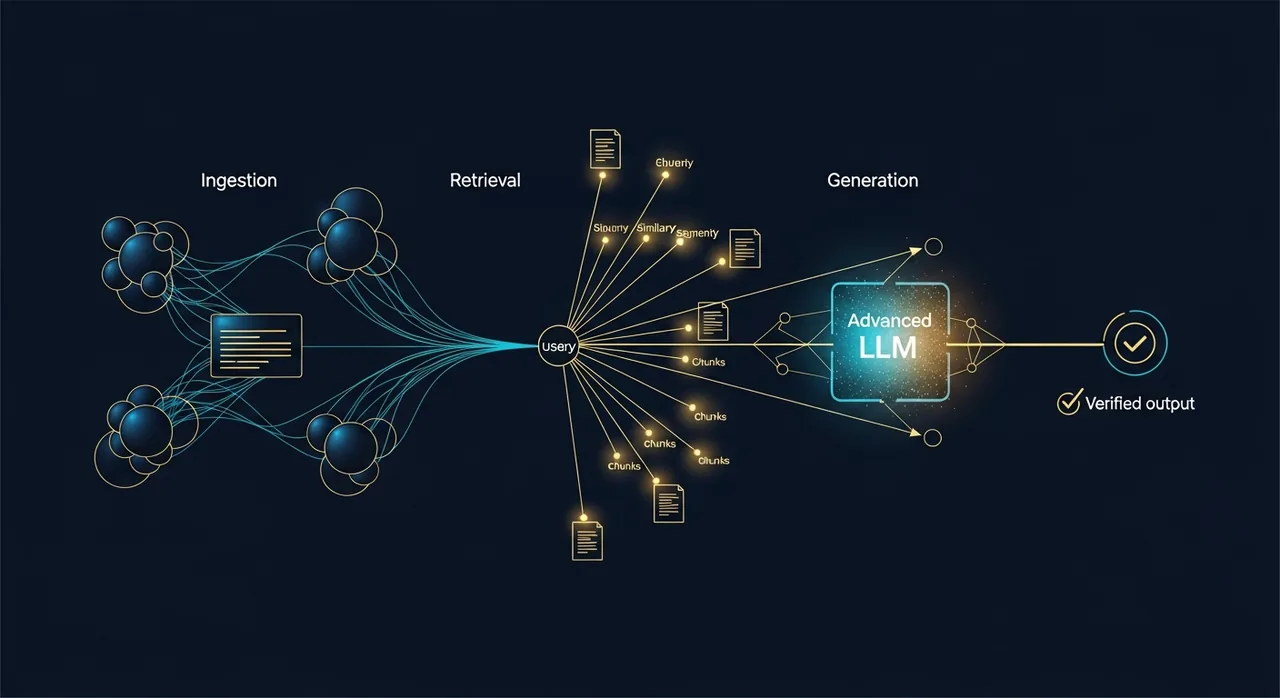
Advanced RAG is the engineering discipline that addresses each of these failure modes systematically. It treats the pipeline as three distinct, optimisable components — Ingestion, Retrieval, and Generation — each with its own failure modes and its own toolkit of solutions.
The Three-Stage RAG Pipeline
1. Ingestion
Clean · Chunk · Embed · Store
2. Retrieval
Match · Rank · Filter · Select
3. Generation
Construct · Generate · Validate
Stage 1: Ingestion
The quality of everything downstream — retrieval accuracy, context relevance, final output — is determined before a single query is run. Ingestion is your foundation, and most teams underinvest in it.
Data Cleaning: The Unglamorous Essential
Raw enterprise data is messy. PDFs have headers, footers, page numbers, and table artefacts. HTML pages carry navigation menus. Scanned documents introduce OCR noise. Before any chunking happens, you need to remove what doesn't belong: strip boilerplate, normalise whitespace, handle special characters, and standardise formatting. For domain-specific corpora — legal contracts, financial reports, clinical notes — this cleaning step is often the most time-intensive part of the entire pipeline, and also the most impactful.
Chunking: The Most Consequential Design Choice
How you split your documents into retrievable units determines whether relevant information can actually be found. There is no universal best approach — only tradeoffs you need to consciously make.

Chunking transforms raw documents into semantically addressable units for vector search
Fixed-Size Chunking
Split by token or character count (e.g. 512 tokens, 100-token overlap). Fast and predictable, but cuts mid-sentence and ignores semantic boundaries. Good for homogeneous, structured text.
Semantic Chunking
Split where meaning shifts — using embedding similarity between sentences to detect natural topic boundaries. Produces more coherent chunks but is slower and requires tuning the similarity threshold.
Recursive Chunking
Split by hierarchy — try paragraph first, then sentence, then character — until chunks reach the target size. A pragmatic middle ground that respects document structure.
Sliding Window / Overlapping Chunks
Chunks overlap by a set number of tokens so context is not lost at boundaries. Helps with retrieval at the edges of topics but increases index size and can introduce redundancy.
Hierarchical / Parent-Child Chunking
Store small child chunks for precise retrieval, but pass the parent chunk (larger context window) to the LLM. Combines retrieval precision with generation context richness.
Metadata: The Hidden Multiplier
Every chunk should carry structured metadata alongside its vector — not as an afterthought, but as a first-class retrieval signal. Good metadata transforms brute-force similarity search into precision filtering.
At minimum, attach: document source and title, section or chapter heading, document date, document type (policy, contract, report, FAQ), and any domain-specific tags relevant to your use case (jurisdiction, product line, risk category). At query time, a user asking about a 2024 policy document should never surface a 2019 version — and metadata filtering is what prevents it.
Embedding: Choosing the Right Representation
Embeddings convert text into vectors in a high-dimensional space where semantic similarity maps to geometric proximity. The choice of embedding model matters significantly. General-purpose models like text-embedding-3-large (OpenAI) or e5-large work well out of the box. For specialised domains — legal, medical, financial — domain-fine-tuned embedders can substantially outperform general ones on retrieval recall.
One often-overlooked issue: embedding asymmetry. The embedding of a short user query and a long document chunk live in the same vector space, but they can be structurally dissimilar even when semantically related. Techniques like HyDE (covered in the retrieval section) address this directly.
Update Strategies: Keeping the Index Fresh
A vector index is not a one-time build. Documents change, new policies replace old ones, and stale content in the index is as dangerous as missing content. How you update the index is an engineering decision with direct consequences for retrieval accuracy and system reliability.
Update Approaches
Full Re-indexing
Rebuild the entire index from scratch on a schedule. Simple to reason about and guarantees consistency, but expensive for large corpora. Acceptable for weekly or monthly update cycles in stable document sets.
Incremental / Delta Updates
Detect changed or new documents since the last index run and add, update, or delete only those records. Requires a reliable change-detection mechanism (document hashes, modification timestamps, a change-data-capture feed). Preferred for high-volume, frequently updated corpora.
Soft Delete + Versioning
Never hard-delete chunks from the index immediately. Mark them with a 'deprecated' flag and a version timestamp. At query time, filter out deprecated chunks unless the user explicitly requests historical versions. Prevents retrieval of replaced content while preserving auditability.
Streaming Ingestion
For real-time knowledge bases — support tickets, news feeds, live transcripts — ingest documents through a streaming pipeline (Kafka, Kinesis) and write to the vector store with low latency. Chunk and embed on-the-fly as documents arrive.
Stage 2: Retrieval

Advanced retrieval layers: dense search → metadata filtering → reranking → final context selection
Query Preprocessing Steps
Before a query ever touches the vector store, it passes through a preprocessing layer that transforms the raw user input into a form optimised for retrieval. Skipping this step is one of the most common reasons RAG systems underperform — the index is fine, but the query is not ready for it.
Query Cleaning & Normalisation
Strip filler phrases, correct typos, normalise casing, and remove stop words that add noise to embedding. A query like 'um what is the, uh, refund policy??' should become 'refund policy' before it hits the encoder.
Intent Classification
Route the query to the right retrieval strategy based on intent. A factual lookup ('What is the interest rate?') warrants keyword-biased retrieval; a reasoning question ('Why did this transaction fail?') benefits from semantic search with broader top-k.
Entity Extraction & Metadata Binding
Detect named entities — dates, product names, regulatory codes, customer IDs — and use them to automatically construct metadata filters. This narrows the search space before a single similarity score is computed.
HyDE — Hypothetical Document Embeddings
Ask the LLM to generate a hypothetical ideal answer to the query, then embed that answer rather than the raw query. Because the hypothetical answer is closer in form to a real document chunk, retrieval recall improves substantially — especially for short or abstract queries.
Query Expansion & Sub-Question Decomposition
Generate multiple phrasings or decompose complex queries into sub-questions, retrieve for each, then aggregate and deduplicate. This captures different perspectives on the same information need and is essential for multi-hop questions.
Step-Back Prompting
For highly specific queries, first retrieve context for a more general version of the question. The broader context often contains the conceptual scaffold needed to answer the specific one accurately.
Hybrid Search: Dense + Sparse
Pure vector (dense) search is strong on semantic matching but weak on exact keyword retrieval. A user querying a specific product code or regulatory clause number needs keyword matching, not semantic approximation. Hybrid search combines dense vector search with sparse keyword search (BM25 or similar) and fuses the two result sets using Reciprocal Rank Fusion (RRF) or a learned score combination. In enterprise settings — where precise terminology, product names, and regulatory identifiers matter — hybrid search consistently outperforms either approach alone.
Metadata Filtering: Narrow Before You Search
Where possible, apply metadata filters before or during vector search rather than after. Filtering to only documents from 2024, only from the compliance policy corpus, or only from a specific jurisdiction before the similarity search runs dramatically reduces the candidate set and improves both precision and latency. Modern vector databases — Pinecone, Weaviate, Qdrant, pgvector — support pre-filtering natively.
Reranking: The Second Pass That Changes Everything
Initial retrieval is optimised for recall: retrieve more than you need, retrieve fast. Reranking is the precision layer — it takes the top-k initial candidates and scores them against the query with a more expensive but more accurate model.
Reranking Approaches
Cross-Encoder Rerankers
Encode the query and each candidate chunk together (not independently) to compute a fine-grained relevance score. Far more accurate than bi-encoder (embedding) cosine similarity. Cohere Rerank, BGE Reranker, and Jina Reranker are strong off-the-shelf options.
LLM-as-Reranker
Ask the LLM itself to score each retrieved chunk for relevance to the query (1–5 scale or binary). Highly accurate for complex queries, but expensive. Best reserved for high-stakes generation where quality justifies the cost.
Maximal Marginal Relevance (MMR)
Select chunks that are relevant to the query AND diverse from each other. Prevents context stuffing where multiple very similar chunks consume the context window and add no incremental signal.
Post-Retrieval Processing Steps
Retrieved and reranked chunks are still raw material. Before they enter the generation prompt, a post-retrieval processing layer refines, compresses, and structures them to give the LLM the best possible signal — with the least possible noise.
Context Compression
Rather than passing full chunks verbatim, use an LLM or extractive summariser to compress each retrieved chunk down to the sentences most relevant to the query. LLMlingua and similar compression models can reduce context by 3–5x while preserving retrieval signal — freeing the context window for more diverse sources.
Deduplication & Overlap Removal
When multiple retrieval strategies (dense, sparse, multi-query) are combined, the same passage may appear in several result sets. Deduplicate by content hash or semantic similarity threshold before passing to the LLM — redundant context does not improve accuracy but consumes tokens and may introduce the 'repetition bias' where the LLM over-weights repeated information.
Relevance Score Thresholding
Enforce a minimum similarity or reranking score before a chunk is admitted to the context. Chunks that pass keyword or semantic retrieval but score poorly at reranking are often tangentially related at best. A hard threshold prevents weak context from muddying generation — better to have fewer, sharper chunks than more, diluted ones.
Citation Mapping & Source Attribution
Before constructing the generation prompt, attach a citation index to each chunk: document ID, section heading, date, page number. Pass this index alongside the content. Instruct the LLM to reference citations inline. This enables downstream faithfulness checks to verify that each claim maps to an actual retrieved source rather than parametric knowledge.
Context Ordering for Attention
LLMs exhibit positional bias — the 'lost in the middle' effect means information placed in the middle of a long context is underweighted. Order your context deliberately: the highest-relevance chunk first, supporting context in the middle, and a secondary high-relevance chunk last. This single structural choice measurably improves answer accuracy on long-context tasks.
Stage 3: Generation — From Context to Verified Output
With high-quality chunks retrieved and reranked, the final stage is constructing the prompt and managing what happens after the LLM responds. Too many systems treat generation as trivial — it is not.
Context Window Management
Passing too many chunks to the LLM introduces the "lost in the middle" problem — LLMs tend to underweight information in the middle of long contexts. Best practice: order retrieved chunks by relevance score (most relevant first and last), set a hard limit on total context tokens, and use the parent-child chunking pattern mentioned earlier to keep passage context rich without ballooning the prompt.
Prompt Construction with Retrieved Context
The structure of how you present retrieved context matters as much as the content. A well-constructed RAG prompt includes: a clear system role, explicit grounding instructions ("Answer only using the provided documents"), the retrieved context blocks with source labels, the user query, and output format instructions. Crucially — always include an out: "If the answer is not present in the documents, say so clearly rather than speculating."
RAG Prompt Template Pattern
System: You are a compliance assistant for a UK financial institution. Answer questions using only the provided policy documents.
Context:
[Document 1 — AML Policy v4.2, Section 3.1]: ...
[Document 2 — Risk Framework 2024, p.14]: ...
User Query: What is the escalation threshold for a politically exposed person alert?
Instructions: If the answer is not contained in the documents above, respond: "This is not covered in the available policy documents." Do not speculate.
Output Validation: Check Before You Serve
Production RAG systems should not blindly serve the LLM's first response. Post-generation validation is where you catch failures before they reach users.
- Faithfulness checking: Verify that every claim in the generated response is grounded in a retrieved chunk. Tools like RAGAS, TruLens, and DeepEval automate this. A faithfulness score below your threshold should trigger a fallback or a human review flag.
- Groundedness / citation verification: If your system cites sources, verify that the cited chunk actually supports the claim. LLMs can hallucinate citations even when given real documents.
- Answer relevance: Does the response actually answer what was asked? Run a separate relevance check using an LLM judge or a fine-tuned classifier. A grounded-but-irrelevant response is still a failure.
- Confidence signalling: If retrieved context is weak (low similarity scores, few results), surface that uncertainty in the response rather than generating confidently from thin evidence.
Advanced Concepts: Beyond the Standard Pipeline
Corrective RAG and Self-RAG
Corrective RAG (CRAG) introduces an evaluation step after initial retrieval. If the retrieved documents score poorly on relevance, the system triggers a web search or secondary retrieval strategy before passing context to the LLM. It treats low-confidence retrieval as a signal to try harder, rather than failing silently.
Self-RAG fine-tunes the LLM itself to decide when to retrieve, what to retrieve, and whether retrieved content is useful — embedding retrieval decisions into the model's generation loop rather than treating them as a fixed upstream step. Highly effective; higher implementation complexity.
Agentic RAG
Rather than a fixed retrieve-then-generate pipeline, Agentic RAG uses an orchestrating agent that can iteratively decide: should I retrieve more? From which source? Should I reformulate the query? Should I verify this sub-claim? This multi-step, self-directing approach handles complex multi-hop questions that single-pass RAG cannot — where answering question A requires first retrieving and processing information B and C.
GraphRAG
Vector similarity captures semantic closeness but not structural relationships. GraphRAG (pioneered by Microsoft Research) builds a knowledge graph over the document corpus alongside the vector index. Entities and their relationships are explicitly represented. At query time, graph traversal retrieves relationship-aware context that pure vector search misses — critical for domains like compliance, where regulatory cross-references and entity relationships are as important as semantic content.
Hierarchical Index Structures (RAPTOR)
RAPTOR (Recursive Abstractive Processing for Tree-Organised Retrieval) builds a tree of progressively summarised document layers. Leaf nodes are raw chunks; parent nodes are LLM-generated summaries of those chunks; root nodes are high-level document abstractions. Retrieval can happen at any level — abstract questions hit high-level nodes, specific questions reach leaf chunks. This is particularly powerful for long documents where a single query might benefit from both a broad structural view and a precise passage.
Building a Production-Ready RAG System: The Checklist
Ingestion
- ✓Systematic data cleaning pipeline
- ✓Semantic or hierarchical chunking
- ✓Metadata schema defined upfront
- ✓Domain-appropriate embedding model
- ✓Chunk quality spot-checks before indexing
Retrieval
- ✓Query optimisation (HyDE or expansion)
- ✓Hybrid dense + sparse search
- ✓Metadata pre-filtering enabled
- ✓Cross-encoder reranking in place
- ✓MMR for diversity when needed
Generation
- ✓Context ordered by relevance score
- ✓Grounding instructions in every prompt
- ✓Explicit 'if not found, say so' instruction
- ✓Faithfulness evaluation on outputs
- ✓Confidence thresholds and fallbacks
Key Takeaways
Ingestion quality is the ceiling of your retrieval quality. Invest in cleaning, chunking strategy, and metadata before tuning anything else.
No single retrieval technique dominates. Combine hybrid search, metadata filtering, and reranking — each layer removes a different class of failure.
Query optimisation (HyDE, expansion, step-back) is often higher-ROI than index optimisation because it addresses failures at the source.
Post-generation validation is not optional in production. Faithfulness scoring and answer relevance checks are the difference between a reliable system and a liability.
Advanced architectures — Agentic RAG, CRAG, GraphRAG — are not complexity for its own sake. They solve specific failure modes that standard pipelines cannot.
A RAG system is only as reliable as its weakest layer. The most common mistake is optimising generation while ignoring ingestion. Fix the data first, then fix the retrieval, then trust the output.
Dr. Nabanita Sinha
Associate Director | AI & Consulting · Author · Mentor