Agentic AI Architecture: A Complete Layer-by-Layer Technical Guide
What does an enterprise-grade agentic AI system actually look like under the hood? This article dissects every architectural layer — from user interaction to infrastructure — explaining what each component does, why it exists, and how the layers work together to make autonomous AI systems reliable, safe, and production-ready.
From AI Features to AI Systems
Most teams encounter agentic AI the same way: they chain a few LLM calls together, add a tool or two, and call it an agent. It works — until it doesn't. The agent loops endlessly. It calls the wrong API. It hallucinates a plan and executes it confidently. It silently fails and nobody notices.
The reason these failures happen is architectural, not algorithmic. Agentic AI is not a smarter chatbot — it is a distributed system where the decision-maker is an LLM. And distributed systems require architecture: separation of concerns, failure modes, state management, observability, and governance. Getting this architecture right is the difference between a prototype and a production system.
This article walks through every layer of a production-grade agentic AI architecture — from the entry point where users interact to the infrastructure layer where LLMs are provisioned — explaining what each layer does, what can go wrong, and how to design it correctly.
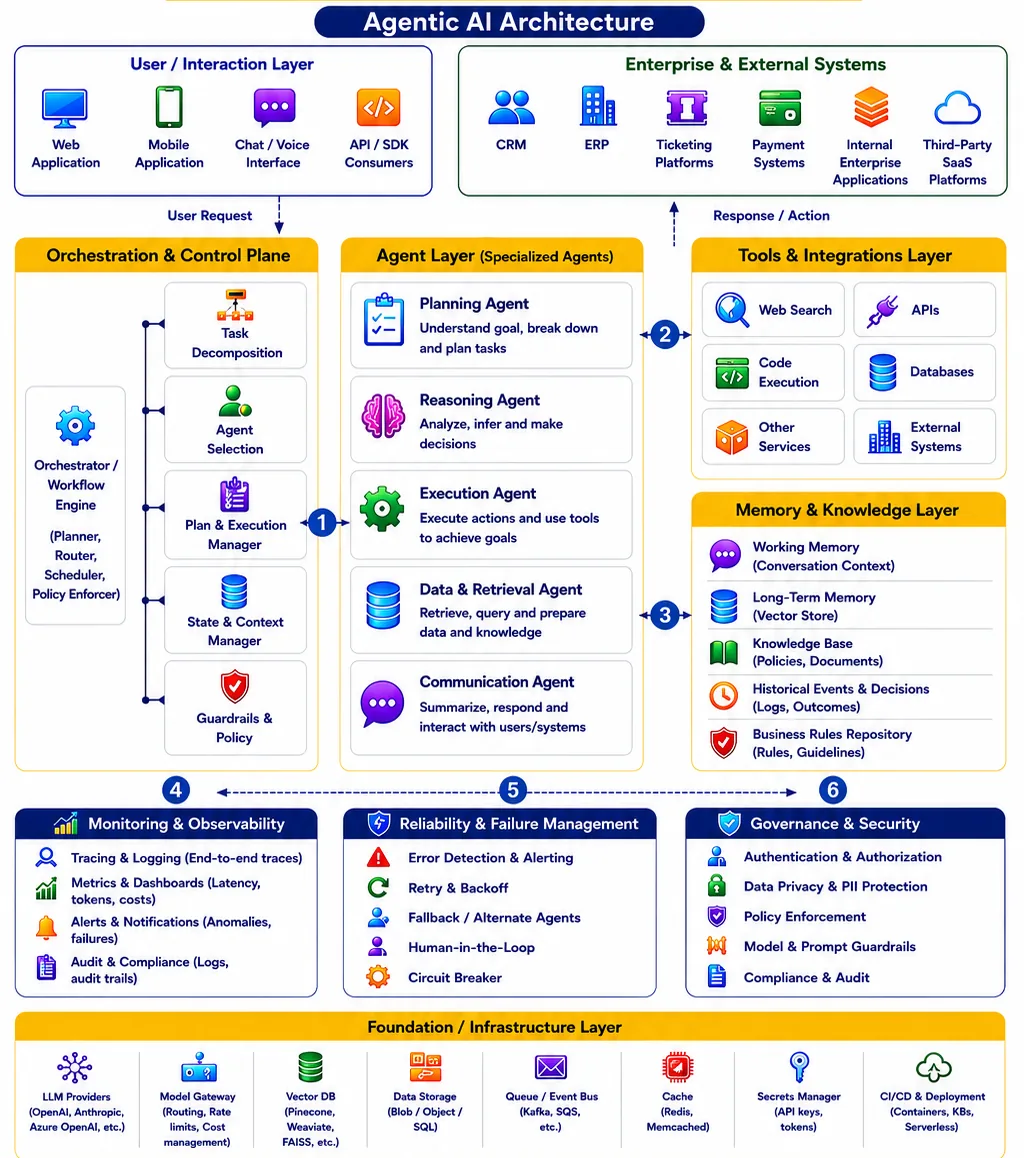
Full agentic AI architecture — nine layers from user interaction to foundation infrastructure, with enterprise system integrations.
The Nine Layers at a Glance
Layer 01
User / Interaction Layer
The entry point — web apps, mobile, chat/voice, API/SDK consumers.
Layer 02
Orchestration & Control Plane
The brain — task decomposition, agent selection, plan & execution management, policy enforcement.
Layer 03
Agent Layer
Specialised agents — Planning, Reasoning, Execution, Data & Retrieval, Communication.
Layer 04
Tools & Integrations Layer
The arms — web search, APIs, code execution, databases, external services.
Layer 05
Memory & Knowledge Layer
The mind — working memory, long-term vector store, knowledge base, business rules.
Layer 06
Monitoring & Observability
The sensors — end-to-end tracing, metrics, alerts, audit logs.
Layer 07
Reliability & Failure Management
The safety net — error detection, retry/backoff, fallback agents, HITL, circuit breakers.
Layer 08
Governance & Security
The rule of law — auth, PII protection, policy enforcement, prompt guardrails, compliance.
Layer 09
Foundation / Infrastructure Layer
The bedrock — LLM providers, model gateway, vector DB, queues, cache, secrets, CI/CD.
Layer 1 — User / Interaction Layer
Every agentic system begins with a request — a human typing a goal, an application submitting a task, or an automated scheduler triggering a workflow. The Interaction Layer is the surface through which these inputs arrive, and it is architecturally more important than it looks.
In production agentic systems, interaction happens through four distinct channels, each with different latency tolerances, trust levels, and formatting requirements:
- Web Application: Browser-based UI — typically a React/Next.js frontend. Well-suited for interactive, human-in-the-loop workflows where the user can review agent output before it is acted upon.
- Mobile Application: iOS/Android native or React Native. Adds constraints around offline behaviour, push notifications for long-running agent tasks, and restricted screen real estate for complex agent output.
- Chat / Voice Interface: Conversational front-ends (Slack bots, Teams apps, voice assistants). Input is inherently unstructured and ambiguous — the Interaction Layer must normalize and validate intent before passing to the orchestrator.
- API / SDK Consumers: Machine-to-machine integration — programmatic callers that submit structured tasks. This is the primary entry point for enterprise workflows where another system (RPA, BPMS, data pipeline) triggers an agent task.
The Interaction Layer's job is not just to receive input — it is to canonicalize it: normalize the request format, authenticate the caller, validate intent, enforce rate limits, and pass a clean, structured task object to the Orchestration Layer. Garbage in, garbage out applies to agentic systems with compounding force — a poorly scoped input task leads to an agent that wanders.
Layer 2 — Orchestration & Control Plane
The Orchestration Layer is the most consequential component in an agentic architecture. It is the system's decision-making brain — receiving goals from the Interaction Layer and translating them into coordinated, executable plans. Everything below it depends on how well it works.
The orchestrator consists of five tightly coupled components:
Task Decomposition
CriticalThe orchestrator receives a high-level goal ("Analyse Q2 sales data and produce a risk summary") and breaks it into a directed acyclic graph (DAG) of atomic sub-tasks. Each node in the DAG is an agent action with defined inputs, expected outputs, and dependencies. Poor decomposition is the root cause of most agentic failures — tasks that are too coarse lead to agent overreach; tasks that are too fine lead to coordination overhead and error propagation.
Agent Selection
RoutingGiven a set of sub-tasks, the orchestrator selects the right agent for each task. This may be deterministic (rule-based routing: 'data retrieval tasks always go to the Data Agent') or dynamic (LLM-based selection based on task description and agent capability profiles). Dynamic selection is more flexible but introduces routing uncertainty — in regulated environments, deterministic routing with capability-based constraints is usually preferable.
Plan & Execution Manager
State EngineManages the execution state of the full task DAG — tracking which sub-tasks are pending, running, completed, or failed; managing sequential and parallel execution; handling partial completions; and making re-planning decisions when a sub-task fails. This is the component that distinguishes a robust agentic system from a brittle one. Frameworks like LangGraph model this as a stateful graph with explicit node transitions; AutoGen models it as message-passing between agents.
State & Context Manager
MemoryMaintains the working context that flows between agents. As sub-tasks complete, their outputs must be propagated correctly to downstream agents — without context window overflow, context contamination between unrelated task branches, or loss of critical intermediate state. The State Manager is responsible for context compression, selective context injection, and session boundary enforcement.
Guardrails & Policy Enforcer
SafetyThe inline enforcement point for the orchestrator's safety constraints. Before any plan node executes, the Policy Enforcer checks: Is this agent authorised to take this action? Does the action exceed defined risk thresholds? Does the tool call comply with data handling policies? This is architecturally distinct from application-level safeguards — it runs inside the control plane, not in the agent itself.
The orchestrator is typically implemented using a framework — LangGraph (stateful graph-based orchestration, best for complex multi-step workflows with conditional branching), AutoGen (multi-agent conversation model, best for collaborative reasoning tasks), or CrewAI (role-based agent crews, best for team-style task delegation). In regulated enterprises, a custom control plane layered over these frameworks is strongly recommended — to add policy enforcement, identity management, and audit logging that off-the-shelf frameworks do not provide.
The ReAct Reasoning Loop
At the core of most orchestrated agentic systems is the ReAct (Reasoning + Acting) pattern — a cyclic loop where the agent alternates between internal reasoning steps and external actions:
Each Observe step ingests tool output or memory. Each Think step is an LLM forward pass producing a reasoning trace. Each Act step calls a tool or delegates to a sub-agent. The loop terminates when the agent produces a final answer or hits a safety/resource limit.
Layer 3 — The Agent Layer: Specialised Agents
The Agent Layer contains the specialised AI components that actually execute work. Unlike a monolithic "one agent does everything" model, production agentic architectures distribute cognition across specialised agents — each optimised for a specific type of task. The architecture diagram defines five canonical agent types:
Planning Agent
Receives a high-level goal and produces a structured plan — a sequence of steps, assigned agents, expected outputs, and dependency constraints. The Planning Agent is the strategic thinker in the system. It uses techniques like Chain-of-Thought (CoT) decomposition, Tree-of-Thought (ToT) for exploring multiple plan branches before committing, and Least-to-Most Prompting for hierarchical task breakdown. In enterprise deployments, the Planning Agent's output should be a machine-readable plan object (JSON DAG), not just natural language — so the orchestrator can execute it deterministically.
Key risk: Over-planning. Agents that decompose too granularly create coordination overhead; agents that plan too broadly create execution ambiguity. The Planning Agent needs explicit scope constraints from the orchestrator.
Reasoning Agent
Handles tasks requiring inference, analysis, and judgment — synthesising information from multiple sources, identifying patterns, resolving contradictions, and producing structured analytical outputs. The Reasoning Agent is the system's analytical engine. It operates primarily on context injected by the State Manager and produces outputs consumed by other agents — not by tools. Chain-of-Thought and self-consistency sampling (generating multiple reasoning paths and selecting the most consistent) are standard techniques here.
Key risk: Hallucination under uncertainty. When the Reasoning Agent lacks sufficient grounding data, it may fabricate plausible-sounding inferences. Grounding checks and confidence scoring should be applied to its outputs before they propagate downstream.
Execution Agent
The action-taker — executes specific tasks by invoking tools, writing code, submitting forms, calling APIs, or making system changes. The Execution Agent translates plans into real-world side effects. It operates with the narrowest scope of any agent type — it should only have access to the tools required for its specific assigned task, not the full tool suite. Every action it takes is logged and subject to gateway enforcement.
Key risk: Blast radius. A misconfigured Execution Agent with broad permissions is an enterprise liability. Least-privilege access, session-scoped tool grants, and hard action limits are non-negotiable for production deployments.
Data & Retrieval Agent
Specialises in information retrieval — querying vector databases, running hybrid searches (BM25 + dense vector), applying reranking, querying SQL/NoSQL stores, and preparing grounded context for other agents. The Data Agent is the RAG specialist in the system. It handles query preprocessing (HyDE — Hypothetical Document Embeddings, Step-Back Prompting), retrieval strategy selection, and context packaging. A well-designed Data Agent returns not just retrieved content but provenance metadata — source, date, confidence — so downstream agents can assess reliability.
Key risk: Retrieval quality degradation. Stale vector stores, poor chunking, or incorrect metadata cause the entire downstream reasoning chain to operate on bad information. Regular retrieval quality audits are essential.
Communication Agent
Handles output formatting and delivery — summarising agent outputs into user-appropriate responses, translating technical results into business language, routing outputs to the correct channel (email, Slack, dashboard, API response), and managing multi-turn conversational context. The Communication Agent is the system's voice. It ensures that technically correct agent outputs are communicated accurately, appropriately, and in the right format for the target audience — a critical layer for any customer-facing or executive-reporting use case.
Key risk: Tone and accuracy drift. The Communication Agent's summarisation step can introduce subtle distortions — reducing a nuanced finding to an oversimplified message. Output validation and human review gates are important for high-stakes communication tasks.
Layer 4 — Tools & Integrations Layer
Tools are the mechanisms through which agents take action in the world. Without tools, an agentic system is just a sophisticated text generator. With tools, it can search the web, execute code, query databases, call APIs, create files, send messages, and interact with external systems.
The Tools & Integrations Layer defines the universe of actions available to agents. Its design has profound implications for system capability, security, and auditability:
- Web Search: Enables agents to retrieve real-time information beyond their training data. Production deployments typically use managed search APIs (Bing, Brave, Google Programmable Search) rather than raw web scraping — for reliability, rate limiting, and compliance. The Data Agent applies retrieval quality filtering to search results before passing them upstream.
- APIs: RESTful or GraphQL endpoints — both internal (microservices, enterprise systems) and external (third-party SaaS, data providers, payment processors). Every API call must pass through the agent gateway for risk scoring and logging. API credentials are never embedded in agent prompts — they live in the Secrets Manager in the Infrastructure Layer.
- Code Execution: The most powerful and dangerous tool — enables agents to write and execute arbitrary code (Python, SQL, JavaScript) in a sandboxed environment. Code execution is the standard approach for data analysis, file processing, and computational tasks. The sandbox must enforce strict resource limits: maximum execution time, memory caps, network isolation, and filesystem restrictions. Code Interpreter-style tools (OpenAI, E2B, Modal sandboxes) provide this in managed form.
- Databases: Direct query access to SQL (PostgreSQL, MySQL), NoSQL (MongoDB, DynamoDB), or time-series stores. Agents should only receive read access by default; write access is granted per-task through the Policy Enforcer. Query result sets must be size-bounded to prevent context overflow.
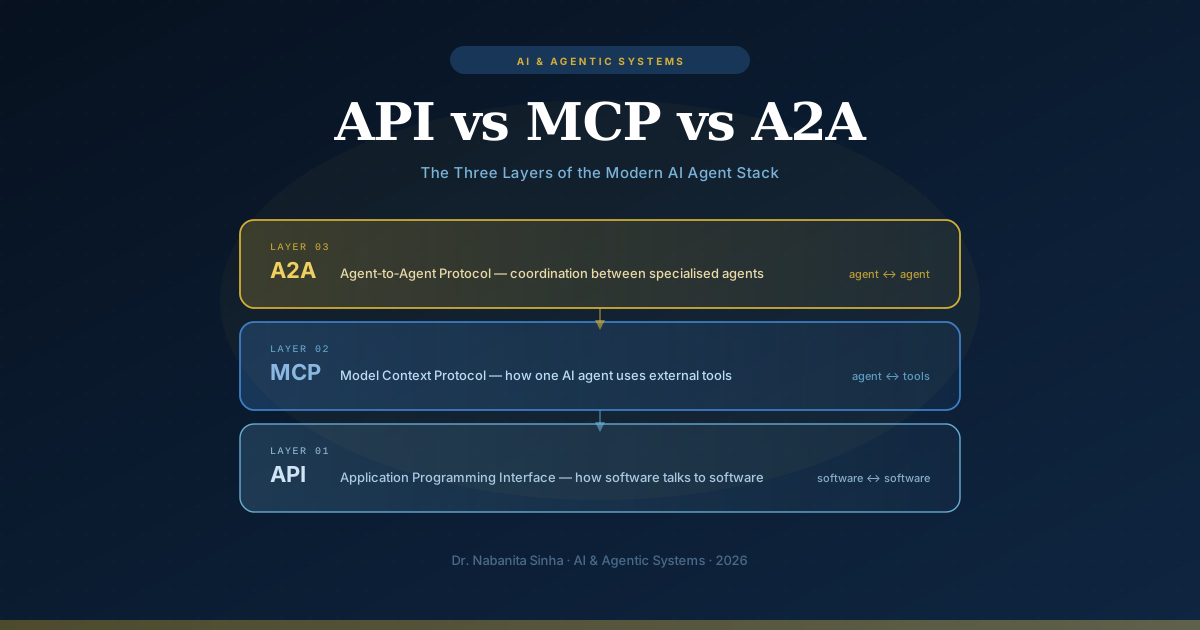
- External Systems: CRM (Salesforce, HubSpot), ERP (SAP, Oracle), ticketing (Jira, ServiceNow), payment systems, and third-party SaaS platforms. These integrations are mediated by the Model Context Protocol (MCP) — an emerging standard that provides a unified interface for agents to discover, authenticate, and call tools across different external systems.
Tool Misuse Is the Leading Cause of Agentic Incidents
The most common production failures in agentic systems are not reasoning errors — they are tool invocation errors: calling the right tool with wrong parameters, calling the wrong tool due to a planning failure, or calling tools in the wrong sequence. Every tool call should be instrumented, logged, and subject to pre-execution policy checks. Tools with destructive side effects (delete, update, send) should require explicit authorisation before execution.
Layer 5 — Memory & Knowledge Layer
Memory is what separates a stateless LLM from a genuine intelligent agent. Without memory, every agent interaction starts from scratch — no awareness of past decisions, no persistent knowledge, no accumulated context. The Memory & Knowledge Layer provides the persistent state substrate that enables agents to learn, reason across sessions, and maintain coherent long-running workflows.
The architecture defines five distinct memory types, each serving a different temporal and semantic scope:
| Memory Type | Scope & Lifetime | Storage Technology | Primary Use |
|---|---|---|---|
| Working Memory | Current session only — resets on session end | In-process state / Redis | Active reasoning chain, current tool outputs, immediate context window |
| Long-Term Memory | Persistent across sessions — indefinite | Vector store (Pinecone, Weaviate, pgvector) | User preferences, past decisions, learned patterns, conversation history |
| Knowledge Base | Persistent — updated on document ingestion | Vector DB + metadata store | Enterprise policies, product documentation, regulatory texts, SOPs |
| Historical Events & Decisions | Persistent — append-only audit log | Object storage (S3, GCS) + queryable log store | Past agent actions, outcomes, escalations — forensic trace and re-learning |
| Business Rules Repository | Persistent — versioned, governed | Relational DB or rules engine (Drools, OPA) | Compliance rules, approval thresholds, routing logic, policy constraints |
Memory architecture introduces three critical engineering challenges that are frequently underestimated:
- Context Window Management: Long-term and knowledge memory retrieved at runtime must fit within the LLM's context window alongside the current task, tool outputs, and system prompt. Context compression (summarisation of historical memory), selective injection (only the most relevant memory chunks), and recency weighting are standard techniques. Embedding models with large context support (e.g., text-embedding-3-large) improve retrieval relevance and reduce injection volume.
- Memory Consistency & Staleness: Knowledge bases and long-term memory stores become stale as policies change, decisions are revised, or facts are updated. Production systems require versioned knowledge ingestion pipelines, staleness detection, and re-indexing triggers on document updates — not just initial ingestion.
- Memory Isolation in Multi-Agent Systems: In a multi-agent architecture, memory access must be scoped to prevent context contamination — Agent A's working memory should not be accessible to Agent B unless explicitly shared through a controlled hand-off. Memory isolation is an access control problem as much as a state management problem.
Layer 6 — Monitoring & Observability
You cannot govern what you cannot see. In agentic systems — where a single user goal can trigger dozens of agent actions, tool calls, and memory retrievals across multiple components — observability is not optional infrastructure. It is the foundation of operational reliability and governance.
The Monitoring & Observability layer covers four domains:
- Tracing & Logging (End-to-End): Distributed tracing spans the full execution path of every agent task — from the initial request through every orchestrator decision, agent invocation, tool call, memory read/write, and final output. OpenTelemetry has become the standard instrumentation layer for agentic systems, enabling trace visualisation in backends like Jaeger, Grafana Tempo, or vendor platforms like LangSmith and Arize Phoenix. Every trace is assigned a unique correlation ID that links all downstream spans — enabling forensic reconstruction of any agent run.
- Metrics & Dashboards: Quantitative performance signals tracked over time: request latency (p50, p95, p99), token consumption per task, tool-call success rates, memory retrieval latency, agent completion rates, cost per task, and error rates by component. Dashboards should surface both operational health and business-level quality metrics (task success rate, hallucination rate, escalation rate) in a single pane.
- Alerts & Notifications: Threshold-based alerts on anomaly conditions: latency spikes, error rate increases, unexpected cost surges, tool-call frequency anomalies, or drift in output quality metrics. Alerts should route to the appropriate owner — operational alerts to on-call engineering, quality alerts to the model validation team, compliance alerts to the governance function.
- Audit & Compliance Logs: A separate, tamper-evident log stream capturing governance-relevant events: agent authorisation decisions, policy enforcement actions, override events, HITL escalations, and agent identity binding per action. This is distinct from operational logs — it exists for compliance evidence and forensic investigation, and must meet the retention requirements of applicable regulations (minimum 3 years in most MRM-governed environments).
Layer 7 — Reliability & Failure Management
Agentic systems fail differently from traditional software. A web server that crashes returns a 500 error immediately. An agentic system that is failing may continue executing — producing wrong outputs, making incorrect tool calls, or consuming resources — for minutes or hours before the failure is detected. Reliability engineering for agentic systems requires patterns that assume failures will occur and design for graceful degradation.
Error Detection & Alerting
Real-time failure detection at every layer — tool call failures, LLM API errors, timeout events, and output validation failures. Detection must be synchronous with execution, not deferred to batch log analysis. Every detected error generates a structured error event with component, task ID, error type, and severity.
Retry & Backoff
Transient failures — network timeouts, LLM rate limits, tool API intermittency — should trigger exponential backoff retry with jitter. Retries must be idempotent: if a tool call was partially executed, retrying must not double-apply its effects. Retry budgets (maximum N retries, maximum retry window) prevent infinite loops on persistent failures.
Fallback / Alternate Agents
When a primary agent or tool fails persistently, the system should fail over to an alternative: a different LLM provider (Claude → GPT-4 → Gemini), a different retrieval strategy, or a simplified deterministic fallback. Fallback chains should be pre-defined and tested, not assembled dynamically under failure conditions.
Human-in-the-Loop (HITL)
The escalation path of last resort — and the most important safety control in high-stakes agentic systems. When an agent cannot proceed (ambiguous task, low confidence, missing authorisation, high-risk action), it must escalate to a human reviewer rather than guessing. HITL queues should surface enough context for reviewers to make informed decisions quickly — not just 'agent needs help'.
Circuit Breaker
Borrowed from distributed systems engineering — a circuit breaker prevents a failing downstream component from cascading failures across the entire system. If a tool API returns errors above a defined threshold, the circuit breaker opens and routes traffic to fallback logic, preventing the agent from hammering a broken endpoint. The circuit periodically attempts to close (half-open state) to detect recovery.
Layer 8 — Governance & Security
Governance and security are not an afterthought layer bolted onto a working system — they are architectural constraints that must be designed into every other layer. A system that works reliably but cannot be governed, audited, or secured is not production-ready for enterprise use.
The Governance & Security layer defines five controls that operate cross-cuttingly across all other layers:
- Authentication & Authorisation: Every agent, every tool call, and every API access must be authenticated against a known identity. OAuth 2.0 with PKCE for user-facing flows; service accounts or SPIFFE/SPIRE workload identities for agent-to-service communication. Authorisation is enforced at the agent gateway — not in the agent's prompt, where it can be overridden. Role-based and attribute-based access control (RBAC / ABAC) govern what each agent identity is permitted to do.
- Data Privacy & PII Protection: PII detection and redaction must operate at both input (user-provided data in task prompts) and output (agent-generated responses that may synthesise PII from retrieved documents). NLP-based PII classifiers (Presidio, AWS Comprehend) should be integrated into the ingestion path and post-processing path. Differential privacy or k-anonymity techniques apply in high-sensitivity domains.
- Policy Enforcement: The Policy Enforcer in the Orchestration Layer is the runtime governance engine — but it needs a policy store to enforce against. Policies are defined using a policy language (OPA/Rego for infrastructure-level policies; structured JSON policy objects for business rules) and evaluated synchronously before every consequential agent action. Policy violations are logged, the action is blocked, and the agent receives a structured refusal — not a silent failure.
- Model & Prompt Guardrails: LLM-level safety controls — input classifiers (reject off-topic, harmful, or adversarial prompts before they reach the LLM), output validators (post-generation safety filters for toxicity, PII, and policy violations), and prompt injection defences (input sanitisation, system prompt hardening, indirect injection detection for RAG pipelines). Nemo Guardrails, Guardrails AI, and LlamaGuard are commonly used frameworks.
- Compliance & Audit: The governance layer must produce evidence — structured audit logs, decision traces, access records, and policy enforcement events — that demonstrate compliance with applicable regulations (GDPR, EU AI Act, MAS AIRG, SR 11-7). Audit artefacts must be immutable, timestamped, and queryable. The Compliance module maps each audit event to its regulatory requirement, enabling automated compliance reporting.
Layer 9 — Foundation / Infrastructure Layer
The Infrastructure Layer is where the agentic system's computational requirements meet the physical (or cloud) reality. It provides the building blocks that every layer above depends on — but most application architects treat it as someone else's problem. In agentic systems, infrastructure choices directly affect latency, cost, reliability, and security posture.
LLM Providers
OpenAI, Anthropic, Azure OpenAI, Google Vertex — multi-provider strategy for resilience and model specialisation.
Model Gateway
Routing, rate limits, cost management, and fallback logic across LLM providers. LiteLLM, Portkey, and Martian are common gateways.
Vector DB
Pinecone, Weaviate, FAISS, pgvector — the persistent store for long-term memory and knowledge base embeddings. HNSW indexing is standard for production retrieval performance.
Data Storage
Blob/object storage (S3, GCS, Azure Blob) for unstructured data; relational stores (PostgreSQL) for structured state; document stores (MongoDB) for semi-structured data.
Queue / Event Bus
Kafka, SQS, RabbitMQ — asynchronous task queuing for long-running agent workflows, decoupling request receipt from execution, and enabling horizontal scaling of agent workers.
Cache
Redis, Memcached — caching LLM prompt/response pairs (semantic caching), tool call results, and frequently retrieved knowledge chunks. Semantic caching (GPTCache, Lago) reduces token costs by 40–70% on repetitive queries.
Secrets Manager
AWS Secrets Manager, HashiCorp Vault, Azure Key Vault — all API keys, tokens, and credentials are injected at runtime, never embedded in code or prompts.
CI/CD & Deployment
Container-based deployment (Kubernetes, ECS) with GitOps workflows, blue/green deployments for model updates, canary releases for agent behaviour changes, and infrastructure-as-code (Terraform) for reproducibility.
Enterprise & External System Integration
The right side of the architecture diagram connects the agentic system to the enterprise's existing software estate — and this is where many real-world deployments face their hardest engineering challenges. Integrating with CRM, ERP, ticketing, payment, and SaaS platforms requires more than just API calls.
- Unified Tool Interface (MCP): The Model Context Protocol (MCP), introduced by Anthropic and now gaining broad industry adoption, provides a standardised client–server protocol for agents to discover and invoke tools. An MCP server wraps each enterprise system (CRM, ERP, internal app) and exposes its capabilities as typed tool definitions. The agent discovers available tools at runtime, without hard-coded integration logic. This dramatically simplifies multi-system integration and enables dynamic tool composition.
- Agent-to-Agent Communication (A2A): Google's Agent-to-Agent (A2A) Protocol addresses inter-agent communication in multi-vendor, multi-framework environments. A2A defines standard message schemas, capability discovery (agent cards), and task delegation patterns that allow agents built on different frameworks (LangGraph, AutoGen, CrewAI) to communicate and collaborate without custom integration code.
- Data Consistency & Transaction Safety: When agentic actions write to enterprise systems (updating CRM records, raising purchase orders, creating tickets), consistency guarantees matter. Agents are not transactional systems — they cannot natively participate in distributed transactions. Compensating transactions (sagas) and idempotent write patterns must be designed into the integration layer.
- Rate Limiting & Backpressure: Enterprise systems have rate limits that are designed for human-paced access, not agent-paced automation. A single agent workflow can exceed hourly API limits in minutes. Integration wrappers must enforce rate limiting, queue excess requests, and surface capacity constraints to the orchestrator — not silently fail.
Choosing an Orchestration Framework
No agentic architecture is complete without an orchestration framework — the software layer that implements the Orchestration & Control Plane. The three dominant frameworks each reflect different architectural philosophies:
| Framework | Model | Best For | Enterprise Consideration |
|---|---|---|---|
| LangGraph | Stateful directed graph — nodes are agents/functions, edges are transitions | Complex multi-step workflows with conditional branching, loops, and explicit state management | Strong observability via LangSmith; good for regulated environments needing explicit workflow documentation |
| AutoGen (Microsoft) | Multi-agent conversation — agents communicate through structured message-passing | Collaborative reasoning, iterative refinement, and tasks requiring agent debate | Less deterministic than LangGraph; harder to audit in regulated environments; better suited for exploratory tasks |
| CrewAI | Role-based crews — agents have defined roles, goals, and backstories within a team | Team-style task delegation where cognitive diversity (different agent roles) improves output quality | Simpler mental model for non-engineers; less control plane flexibility; limited enterprise governance hooks out of the box |
For enterprise regulated environments, none of these frameworks alone is sufficient — all require a custom governance layer (agent gateway, identity management, policy enforcement, audit logging) wrapped around them. The framework choice should be driven by the workflow complexity and team familiarity, not by the assumption that the framework itself provides enterprise-grade governance.
Five Architecture Principles for Production Agentic Systems
Principle of Least Privilege
Every agent gets the minimum tool access, memory access, and action scope required for its specific task. Broad grants are a blast radius problem, not a convenience feature. Scope access per task context, not per agent type.
Fail Explicitly, Never Silently
Agents that cannot proceed must surface structured failures — not guess, hallucinate a workaround, or silently omit steps. Explicit failure with context enables recovery; silent failure enables cascading errors.
Everything is Auditable
Every agent action, tool call, memory access, and governance decision must be logged with sufficient context for forensic reconstruction. If an action cannot be attributed to a specific agent identity and a specific task, it should not be allowed to execute.
Autonomy Scales With Confidence
Low-risk, well-understood actions should be fully autonomous. High-risk, novel, or ambiguous actions should require human review. The boundary between these categories must be defined by policy, not by the agent's own assessment of its confidence.
Governance Is Architecture, Not Policy
Policy documents do not govern agentic systems — code does. Guardrails, access controls, rate limits, and kill switches must be implemented at the architecture level (gateway, identity layer, policy engine) — not expressed only in system prompts that the agent can be manipulated into ignoring.
The Architecture Principle
"Agentic AI is a distributed system where the decision-maker is an LLM. It requires distributed systems architecture — not just a better prompt."
The nine-layer architecture described here is not aspirational — it is the minimum viable architecture for a production agentic system operating at enterprise scale. Every layer addresses a class of failure that will occur in production. The question is whether you design for it in advance or discover it after the fact.
Conclusion
Building an agentic AI system that works in production requires confronting the full complexity of the problem — not just the LLM layer, but the nine architectural layers that make autonomous reasoning safe, reliable, and auditable at scale. From the Interaction Layer that canonicalises user intent, through the Orchestration & Control Plane that translates goals into executable plans, to the Foundation Infrastructure that provisions the compute and storage substrate — each layer has specific design requirements and specific failure modes.
The five specialised agent types — Planning, Reasoning, Execution, Data & Retrieval, and Communication — distribute cognition across a system optimised for each task type. The Memory & Knowledge Layer provides the persistent state that enables cross-session learning. The Monitoring, Reliability, and Governance layers ensure the system is observable, resilient, and accountable.
Emerging protocols — MCP for tool integration and A2A for inter-agent communication — are accelerating the standardisation of agentic architectures and reducing the custom integration burden. Orchestration frameworks like LangGraph, AutoGen, and CrewAI provide the workflow execution engine, though enterprise deployments require a custom governance layer wrapping any framework.
The organisations building production agentic systems today are the ones investing in this full architectural stack — not just the AI models, but the infrastructure, governance, and operational patterns that make those models trustworthy and deployable at scale.
References & Further Reading
- [1]Yao et al. ReAct: Synergizing Reasoning and Acting in Language Models. ICLR 2023.
- [2]Wei et al. Chain-of-Thought Prompting Elicits Reasoning in Large Language Models. NeurIPS 2022.
- [3]Anthropic. Model Context Protocol (MCP) — Open Standard for Agent Tool Integration. 2024.
- [4]Google DeepMind. Agent-to-Agent (A2A) Protocol Specification. 2025.
- [5]LangChain. LangGraph: Building Stateful, Multi-Actor Applications. Documentation, 2024.
- [6]Microsoft Research. AutoGen: Enabling Next-Gen LLM Applications via Multi-Agent Conversation. arXiv:2308.08155, 2023.
- [7]OpenAI. Best Practices for Building Agentic Systems. Technical Guide, 2024.
- [8]NIST. AI Risk Management Framework 1.0. Gaithersburg, MD, Jan. 2023.
- [9]Weng, Lilian. LLM-powered Autonomous Agents. Lil'Log. June 2023.
- [10]Lewis et al. Retrieval-Augmented Generation for Knowledge-Intensive NLP Tasks. NeurIPS 2020.
- [11]Shinn et al. Reflexion: Language Agents with Verbal Reinforcement Learning. NeurIPS 2023.
- [12]Park et al. Generative Agents: Interactive Simulacra of Human Behavior. arXiv:2304.03442, 2023.