AgenticOps: The Operational Discipline for Running AI Agents at Enterprise Scale
Deploying an AI agent is easy. Operating it reliably, safely, and at scale — across teams, workflows, and regulatory boundaries — is the hard part. AgenticOps is the emerging discipline that closes this gap, borrowing from DevOps and MLOps to bring operational rigour to the age of autonomous AI.
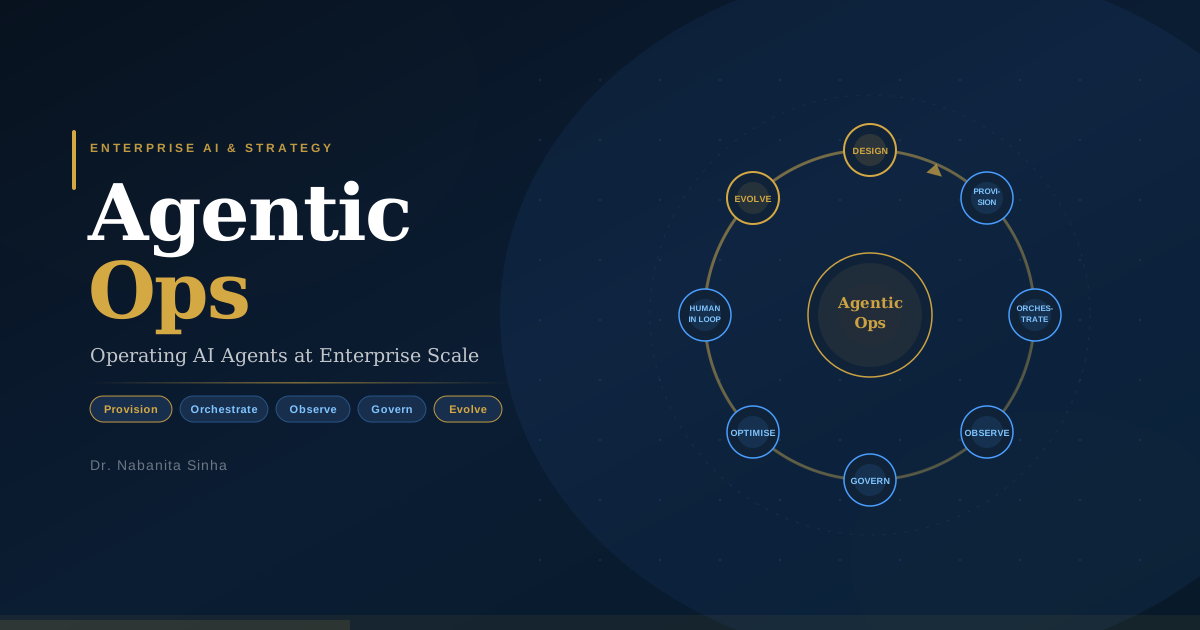
Enterprise AI Operations
Design · Orchestrate · Observe · Govern · Evolve
From Deployment to Operations: The Gap No One Talks About
The enterprise AI conversation is dominated by a single question: Can we build this agent? Teams invest months selecting frameworks, tuning prompts, integrating tools, and validating accuracy. Then the agent goes live — and a different, harder set of questions emerges: How do we know it is still behaving correctly next week? What happens when it drifts? Who is responsible when it takes an incorrect action? How do we update it without breaking downstream workflows?
These are operational questions, not engineering questions. And unlike engineering — which has decades of mature tooling and discipline — the operational layer of agentic AI is, for most organisations, almost entirely unbuilt.
AgenticOps is the answer. It is the emerging operational discipline — drawing from DevOps, MLOps, and DataOps — that treats AI agents not as one-time deployments but as long-running operational entities that must be provisioned, monitored, governed, optimised, and eventually retired with the same rigour applied to any other enterprise system.
AgenticOps in Context: How It Relates to Existing Disciplines
AgenticOps is not a replacement for DevOps or MLOps — it is a layer that sits above them, addressing the operational concerns that are unique to autonomous, reasoning systems.
| Discipline | Traditional Focus | AgenticOps Extension |
|---|---|---|
| DevOps | Code deployment pipelines | Agent deployment & rollback |
| MLOps | Model training & serving | Agent reasoning & decision monitoring |
| DataOps | Data pipeline reliability | Context & retrieval pipeline quality |
| AgenticOps | Autonomous agent lifecycle | Full stack: design → operate → evolve |
The critical distinction: DevOps manages code that does what it is told. MLOps manages models that predict from patterns. AgenticOps manages agents that decide and act — a qualitatively different operational challenge, because the failure modes are non-deterministic, context-dependent, and often invisible until they compound.
The Eight Pillars of AgenticOps
A mature AgenticOps practice is built on eight interdependent operational pillars. Each addresses a distinct risk surface in the agent lifecycle — skip one, and the gaps compound into incidents.
Agent Design & Provisioning
Defining agent purpose, scoping permissions, assigning identity, and registering each agent in a centralised catalogue before deployment.
Workflow Orchestration
Coordinating multi-step, multi-agent processes — managing task handoffs, dependency resolution, and parallel execution across agent networks.
Real-Time Observability
Monitoring agent reasoning, tool-call patterns, decision traces, and session state in real time — not as an audit afterthought.
Performance & Cost Management
Tracking latency, throughput, token efficiency, and cost-per-query to sustain operational SLAs without runaway inference spend.
Governance & Policy Enforcement
Applying access controls, action limits, audit logging, and compliance guardrails systematically across every agent in the deployment.
Human-in-the-Loop Integration
Routing high-risk or uncertain agent decisions to human reviewers through structured approval queues with full decision context.
Continuous Learning & Drift Control
Detecting behavioural drift, retraining on feedback signals, and updating agent instructions without redeploying entire pipelines.
Agent Lifecycle Management
Managing agent versioning, dependency tracking, controlled transitions, and knowledge handoff when agents are upgraded, replaced, or phased out.
Pillar 1 — Agent Design & Provisioning
An agent that is not designed for operability is difficult to operate. AgenticOps begins at design time, not at deployment. Before an agent is released into production, it must have a clearly defined purpose, a bounded scope of action, a unique identity, and an entry in a centralised agent registry.
- Purpose specification: Every agent should have a written, version-controlled definition of what it does, what it does not do, and what success looks like. Vague purpose definitions are the root cause of the majority of agentic drift incidents.
- Permission scoping: Access grants are assigned at provisioning time, scoped to the minimum required for the agent's defined purpose. No broad administrative grants. No "we'll restrict it later" deferrals.
- Identity assignment: Each agent receives a unique service identity — a cryptographic credential that distinguishes it from every other agent in the system. This enables audit attribution, session tracking, and targeted suspension when needed.
- Agent registry entry: The agent's purpose, owner, granted permissions, deployed environment, and last-reviewed date are recorded in a central catalogue. If an agent is not in the catalogue, it should not be running.
Pillar 2 — Workflow Orchestration
A single agent solving a single task is a prototype. A production enterprise AI system is a network of agents collaborating on complex, multi-step workflows — and orchestration is what makes that network reliable.
Orchestration in the AgenticOps context covers more than routing: it defines how tasks are decomposed, how subtasks are assigned to specialist agents, how outputs are validated before being passed downstream, and how the workflow recovers when a component fails.
- Task decomposition patterns: Complex goals are broken into discrete, verifiable subtasks. Each subtask has a defined input format, output schema, and acceptance criteria. This makes individual agent outputs testable and the overall workflow debuggable.
- Parallel vs. sequential routing: Independent subtasks run in parallel to minimise latency. Dependent tasks enforce ordering. The orchestration layer enforces this topology — agents should not need to know about each other's scheduling constraints.
- Output validation at handoff: Before an agent's output is passed to the next stage, a validation step checks schema conformance, content safety, and business rule compliance. Catching errors at handoff is orders of magnitude cheaper than catching them at the end of a pipeline.
- Failure handling and retry logic: Every workflow path has a defined failure mode and recovery strategy — retry with backoff, route to a fallback agent, escalate to a human queue, or gracefully terminate and log. Silent failures that swallow errors and continue are not acceptable in regulated environments.
Pillar 3 — Real-Time Observability
Traditional application observability tracks what code did. Agent observability must track what the agent decided — and why. This is a fundamentally different instrumentation problem, requiring new tools and new mental models.
An agent that produces a wrong answer and an agent that produces a correct answer may generate indistinguishable logs if your observability stack is built for deterministic software. AgenticOps requires observability that captures the reasoning chain, not just the result.
- Decision tracing: Every agent action — tool call, retrieval query, reasoning step, output generation — is logged with the inputs it received, the options it considered, and the choice it made. This enables post-hoc reconstruction of any agent session for audit or debugging.
- Real-time dashboards: Operations teams need live visibility into agent session counts, active workflows, tool-call rates, error rates, and escalation queue depth. Not yesterday's data — current state, with anomaly alerting.
- Semantic monitoring: Beyond quantitative metrics, monitor whether agent outputs remain semantically aligned with their stated purpose. Embedding-based similarity scoring between current outputs and a validated baseline distribution detects agents that are "off-script" before they violate a formal rule.
- Session replay: The ability to replay a specific agent session — re-running the same inputs through the same reasoning path — is essential for root-cause analysis. Agents that cannot be replayed cannot be reliably debugged.
Pillar 4 — Performance & Cost Management
AgenticOps teams are accountable for two performance curves simultaneously: the user-facing curve (latency, reliability, output quality) and the operational curve (cost per query, inference efficiency, resource utilisation). These curves often trade off against each other, and managing the tradeoff requires explicit measurement.
- Model routing optimisation: Not every query needs a frontier model. Agents should route requests to the smallest model capable of meeting the quality bar for that task class. Routing all traffic to the most capable model is convenient but economically unsustainable at scale.
- Context window discipline: Long context windows are expensive. Agents that accumulate context indiscriminately — adding conversation history, tool outputs, and retrieved documents without pruning — generate runaway token costs. Context management is a first-class AgenticOps concern.
- Caching and pre-computation: Deterministic tool outputs, repeated query results, and stable knowledge-base retrievals should be cached aggressively. A well-designed caching layer can reduce retrieval costs by 40–70% for enterprise workflows with recurring query patterns.
- Cost attribution: Every inference cost is attributed to a specific agent, workflow, team, and task class. Without granular attribution, cost optimisation is guesswork. With it, the highest-cost operations become visible — and targetable.
Pillar 5 — Governance & Policy Enforcement
In regulated industries — financial services, healthcare, critical infrastructure — agent governance is not optional. It is the difference between a production-grade AI programme and a liability. AgenticOps operationalises governance by moving it from a design-time checklist to a runtime enforcement layer.
The Governance Gap
Most organisations govern AI at design time (architecture reviews, risk assessments) but not at runtime. An agent that passes a design review can still drift, be prompted injected, or accumulate permissions over time. Runtime enforcement is non-negotiable.
- Policy-as-code: Access controls, action limits, prohibited operations, and data handling rules are expressed as machine-readable policies — not documentation. These policies are evaluated automatically at every agent action, not reviewed quarterly by a committee.
- Audit logging: Every agent action that touches sensitive data, crosses a financial threshold, communicates externally, or modifies a system state is logged with full attribution: which agent, which session, which inputs, which decision, which output. The log chain must support forensic reconstruction.
- Regulatory alignment: Policies map explicitly to regulatory requirements — whether GDPR data minimisation, SR 11-7 model risk management, FCA operational resilience standards, or EU AI Act high-risk system obligations. Compliance is not separate from operations — it is embedded in the operational framework.
Pillar 6 — Human-in-the-Loop Integration
Autonomous does not mean unattended. AgenticOps builds structured human oversight into agent workflows — not as an emergency failsafe, but as a designed, tested, first-class component of the operational architecture.
The goal is not to make humans review every agent action. That defeats the purpose of autonomy. The goal is to route the right actions — those with high stakes, high uncertainty, or low confidence — to human reviewers, with enough context to make a decision in seconds rather than minutes.
- Tiered escalation: Actions are classified by impact and uncertainty. Low-impact, high-confidence actions run autonomously. Medium-impact or uncertain actions trigger a soft confirmation. High-impact or policy-adjacent actions require explicit human authorisation before execution.
- Context-rich approval queues: Reviewers receive the full decision context — what the agent was asked to do, what it planned to do, what alternatives it considered, and what the consequences of approval or rejection are. Reviewers should never need to investigate to make a decision.
- Reviewer feedback as training signal: Every human approval and rejection is a labelled data point. Over time, this feedback loop improves the agent's escalation calibration — reducing unnecessary escalations while maintaining appropriate oversight on genuinely risky actions.
Pillar 7 — Continuous Learning & Drift Control
Autonomous AI agents are not static. Their operating environment changes — data distributions shift, business rules evolve, user query patterns change — and agents that do not adapt become unreliable. AgenticOps manages this evolution systematically, rather than reacting to it when incidents occur.
- Behavioural baseline profiling: At deployment, capture a statistical baseline of the agent's behaviour: typical tool-call frequency, average reasoning depth, normal session duration, standard output length. Deviations from this baseline — even subtle ones — are early signals of drift.
- Drift thresholds and alerting: Define statistical thresholds (e.g., tool-call frequency exceeding 2σ above baseline) that trigger automated alerts. This avoids the brittleness of hard-coded rule violations while remaining auditable and adjustable.
- Feedback-driven instruction updates: When user corrections, HITL rejections, or monitoring signals indicate a systematic accuracy gap, the agent's system prompt, retrieval configuration, or tool definitions are updated through a controlled change management process — not ad hoc prompt edits by individual engineers.
- A/B evaluation before promotion: Agent updates are validated in a staging environment against the production baseline before release. Rollback procedures are defined and tested before any change goes live.
Pillar 8 — Agent Lifecycle Management
Every agent has a lifecycle — from provisioning through production operation to eventual phase-out. AgenticOps treats the end of an agent's active life as seriously as its deployment, because an improperly transitioned agent can leave orphaned permissions, dangling integrations, and undocumented knowledge gaps that become operational liabilities.
- Version control for agents: Agent configurations — system prompts, tool definitions, permission sets, retrieval indices — are version-controlled with the same rigour as application code. Every change is tracked, attributed, and reversible.
- Dependency mapping: Before phasing out an agent, its downstream dependencies are mapped: which workflows consume its outputs, which tools are registered under its identity, which data stores it has write access to. Unresolved dependencies are explicitly handled before transition.
- Knowledge transfer: When an agent is replaced — by a newer version or a different architecture — the operational knowledge accumulated in its decision traces, escalation history, and feedback signals is preserved and made available to its successor.
- Permission revocation: When an agent is phased out, its service identity is revoked, access grants are explicitly closed, and its registry entry is marked inactive with a recorded date and reason. No permissions carry over unreviewed.
The AgenticOps Maturity Model
Most enterprises are not at full AgenticOps maturity — and they do not need to be immediately. What matters is understanding where you are and having a clear path to where you need to be. This four-level model provides a practical framework for assessing and advancing maturity.
Level 1 — PoC / Ad Hoc
Agents exist as experiments, not operations. Individual teams build to prove a use case — no shared infrastructure, no identity registry, no logging, no governance. Success is demo quality, not reliability. There is no clear path to production: permissions are over-scoped, outputs are unaudited, and no production readiness plan exists.
Level 2 — Monitored
Agents enter production but remain poorly understood. Session logs, latency, and error rates are tracked per agent. High-risk actions route to human review informally. Teams know when something breaks — but not why it drifted, what its normal behaviour looks like, or which downstream workflows are at risk.
Level 3 — Governed
Operations become systematic. A centralised catalogue holds every production agent — identity, purpose, permissions, and owner. Policy-as-code enforces access controls without relying on individual discipline. Structured approval queues handle escalations with full context. Drift detection runs continuously against behavioural baselines. The organisation knows what it is running, who owns it, and what the limits are.
Level 4 — Optimised
AgenticOps becomes self-improving. Drift triggers automated remediation — not manual alerts. HITL feedback feeds directly into instruction updates through validated pipelines. Every inference call is tracked to the team and workflow that triggered it, so leadership sees what AI costs and why — enabling smarter model routing decisions. Agents are upgraded, tested, and transitioned with minimal manual effort. Operational discipline compounds into lasting competitive advantage.
Most enterprise teams entering serious agentic AI programmes today are at Level 1 or transitioning to Level 2. The practical goal for 2026–2027 is reaching Level 3 — centralised governance, policy enforcement, and structured observability — before agent populations scale beyond the point where manual oversight is feasible.
The Core Principle
"An autonomous agent that cannot be observed cannot be trusted. An autonomous agent that cannot be governed cannot be scaled. AgenticOps is what makes both possible."
The organisations building AgenticOps infrastructure today are making a long-term bet: that the operational discipline they invest in now will compound into a durable competitive advantage as their agent populations grow from dozens to hundreds.
Practical Starting Points: Where to Begin
AgenticOps is a programme, not a project. It cannot be implemented in a single sprint, and it should not be attempted all at once. The following three-phase approach provides a pragmatic sequence for teams moving from ad hoc agent operations to a governed, observable, optimised practice.
- Phase 1 — Foundation (Weeks 1–6): Establish an agent registry. Assign unique identities to all production agents. Implement structured logging for every agent session — inputs, reasoning steps, tool calls, outputs. Define a basic escalation policy for high-risk actions. None of this requires new tooling — it requires discipline. The payoff is immediate: full visibility into what is running and what it is doing.
- Phase 2 — Control (Months 2–4): Implement policy-as-code for access controls and action limits. Establish a centralised approval queue for HITL escalations. Define behavioural baselines for each production agent and deploy automated drift alerts. Map agent dependencies in preparation for lifecycle management.
- Phase 3 — Optimise (Months 4–8): Build cost attribution reporting. Implement model routing for multi-tier inference. Establish A/B evaluation pipelines for agent updates. Develop lifecycle transition procedures and test them on a lower-risk agent. Build feedback loops that route HITL decisions back into agent instruction updates.
Conclusion: Operational Excellence as a Competitive Advantage
The enterprise AI landscape is moving quickly from proof-of-concept agents to production agent programmes — networks of dozens or hundreds of specialised agents operating across business functions, handling real decisions, and generating real consequences. The organisations that will lead this transition are not necessarily those with the most capable models. They are the ones that build the operational infrastructure to run those models reliably, safely, and at scale.
AgenticOps is that infrastructure. It is the discipline that transforms agentic AI from a promising technology into a dependable operational capability — one that can be audited, improved, and trusted with the complexity of real enterprise environments.
References & Further Reading
- 1.IBM (2026). What is AgentOps? Lifecycle management for autonomous AI agents.
- 2.Gartner (2026). Hype Cycle for Artificial Intelligence — Agentic AI and Operational Readiness.
- 3.NIST AI RMF (2024). AI Risk Management Framework — Autonomous Systems Supplement.
- 4.International Journal of AI, Data Science & Machine Learning (2026). Enterprise Agentic AI Lifecycle Governance: A Control-Driven Framework from Design to Decommissioning.
- 5.Cisco (2026). AgenticOps: Operational Frameworks for Enterprise AI Agent Deployment and Governance.
- 6.Open Policy Agent Project (2026). Policy-as-Code for Distributed Systems.
- 7.EU AI Act (2024). High-Risk AI Systems: Obligations for Providers and Deployers.
- 8.SPIFFE/SPIRE Project (2026). Workload Identity Standards for Distributed Systems.