The Architecture of Controlled Autonomy: Governing Enterprise AI Agents
As organisations move from static AI assistants to agents that plan, execute, and iterate across complex multi-step tasks, the risk profile of enterprise software has fundamentally shifted. Controlled Autonomy is the framework that bridges agentic capability with operational stability — treating AI agents as identity-bearing, auditable entities within your enterprise architecture.
From Capable to Accountable
The promise of autonomous AI agents is real: they can decompose goals, invoke tools, query databases, trigger APIs, and refine their own outputs without constant human hand-holding. But that same capability — unmonitored — becomes automated, uncontrolled risk.
The shift enterprises must make is not from "no AI" to "AI everywhere." It is from black-box deployment to Controlled Autonomy — a governance posture where every agent action is attributable, every policy violation is interceptable, and every anomaly triggers an audit trail, not a silent failure.
This is not a theoretical framework. It is an operational architecture with seven distinct, implementable controls.
Approval Workflows & Human Oversight
High-impact actions require human review before execution. Autonomy scales with confidence, not with convenience.
AI Agent Gateways
Real-time execution checkpoints — every tool call is evaluated against risk policies before it runs.
Identity & Auditability
Every agent has a unique identity (OAuth 2.0 / SPIFFE). Decision traces ensure non-repudiation.
Least-Privilege Scoping
Access scoped per task — no broad administrative grants. An agent that summarises documents needs no database access.
Behavioral Monitoring & Drift Detection
Continuous monitoring of tool-call frequency, reasoning chain length, and escalation rates.
Action Limits & Operational Boundaries
Hard transaction thresholds, session action limits, and restricted operations keep small errors from becoming large incidents.
Emergency Kill Switches
Instant, automated suspension on policy violation. Pull the plug. Stop the risk.
1. Approval Workflows & Human Oversight
The most common mistake in agentic system design is treating autonomy as a binary — either the agent runs fully independently, or a human does everything manually. In practice, the right answer is a graduated autonomy model: agents operate independently for low-stakes, well-understood tasks, and escalate to human review when the stakes or uncertainty rise.
Not every action should be fully autonomous. High-impact activities — customer communications at scale, financial transactions above defined thresholds, policy or configuration changes, production deployments, or regulatory submissions — warrant human review and approval before execution. The principle is simple: autonomy must scale with confidence, not with convenience.
- Tiered Approval Gates: Define action categories by impact level. Tier 1 (read, summarise, draft) runs autonomously. Tier 2 (send, update, transact below threshold) requires a soft confirmation. Tier 3 (delete, deploy, submit externally) requires explicit human sign-off before execution.
- Human-in-the-Loop (HITL) Queues: High-risk agent actions should not silently wait or silently fail — they should route to a managed approval queue with context: what the agent planned to do, why, and what happens if approved or rejected. Reviewers need enough information to make an informed decision in seconds, not minutes.
- Confidence-Based Escalation: Agents that can self-report uncertainty (through structured output validation, low-confidence flags, or ambiguity signals) should automatically escalate when their confidence falls below a threshold. This prevents silent errors where the agent "guesses" on a high-stakes task.
Implementing approval workflows also has a secondary benefit: it generates labelled data on what humans approve and reject, creating a feedback loop that can improve agent decision-making over time.
2. AI Agent Gateways: The Execution Checkpoint
In traditional software, a security perimeter guards the boundary between outside and inside. In agentic architectures, the threat surface moves inside — an agent that already has system access can make hundreds of tool calls per session. The gateway is your last reliable control point.
Unlike static firewall rules, an agentic gateway evaluates intent and impact in real time, not just origin. Every tool invocation — whether that is a database query, an API write, or a file system operation — passes through the gateway before execution.
- Risk Scoring: Each action is assigned a risk score based on operation type (read vs. write), data sensitivity (internal vs. PII-adjacent), and scope (single record vs. batch). A low-risk read is auto-approved; a high-risk financial write triggers human-in-the-loop (HITL) review.
- Policy Enforcement: If a request exceeds a threshold or violates a safety guardrail, the gateway blocks the action and logs the attempt. The agent receives a structured refusal — not a silent hang — and the HITL queue is notified.
- Contextual Awareness: Gateways can incorporate session context — if an agent has made 40 write calls in the last 60 seconds, that itself is a risk signal, even if each individual call is low-risk.
The practical implementation often combines an API gateway layer (e.g., Kong, AWS API Gateway) with a custom policy engine (Open Policy Agent is a common choice). The key is ensuring the gateway is in the critical path, not bolted on as a logging afterthought.
3. Identity, Auditability, and the Shadow AI Challenge
Shadow AI — agents and AI tools deployed by teams without IT visibility — is the enterprise governance equivalent of shadow IT, but with a materially higher blast radius. An unmanaged LLM pipeline with write access to a CRM or financial system, operating outside any audit trail, is not a productivity tool. It is a liability.
Shadow AI = Blind Risk
Unsanctioned tools and agents create visibility gaps and uncontrolled risk. If an agent's actions cannot be attributed to a specific identity, they cannot be audited, investigated, or reversed.
The solution is to treat every AI agent as a first-class identity within your IAM (Identity and Access Management) framework.
- Unique Service Identities: Use OAuth 2.0 client credentials or SPIFFE/SPIRE workload identity standards to assign each agent a distinct, verifiable identity. This means that when an agent accesses a database or calls an external API, the action is logged against that specific agent's identity — not a generic service account.
- Decision Provenance: Beyond logging what happened, effective governance captures why. Decision traces record the inputs the agent considered, the alternatives it evaluated, and the reasoning path that led to the action. This is not optional for regulated industries — it is the foundation of audit readiness and non-repudiation.
- Inventory Management: Every deployed agent should be registered in a centralised agent catalogue — its purpose, owner, granted permissions, last-reviewed date, and deployed environment. An agent that is not in the catalogue should not be running.
5. Behavioral Monitoring and Drift Detection
Traditional software behaves deterministically: the same input produces the same output. AI agents do not. They are non-deterministic by design, and their behaviour can evolve through runtime interactions, updated data sources, stale memory, or subtle shifts in environmental context. An agent that is safe at deployment may drift.
Drift is not always dramatic. It can manifest as gradually increasing reasoning chain lengths (the agent is "overthinking" and departing from its intended scope), rising escalation rates (the agent is encountering more edge cases than expected), or subtle shifts in tool-call patterns (an agent that was primarily reading is now writing with increasing frequency).
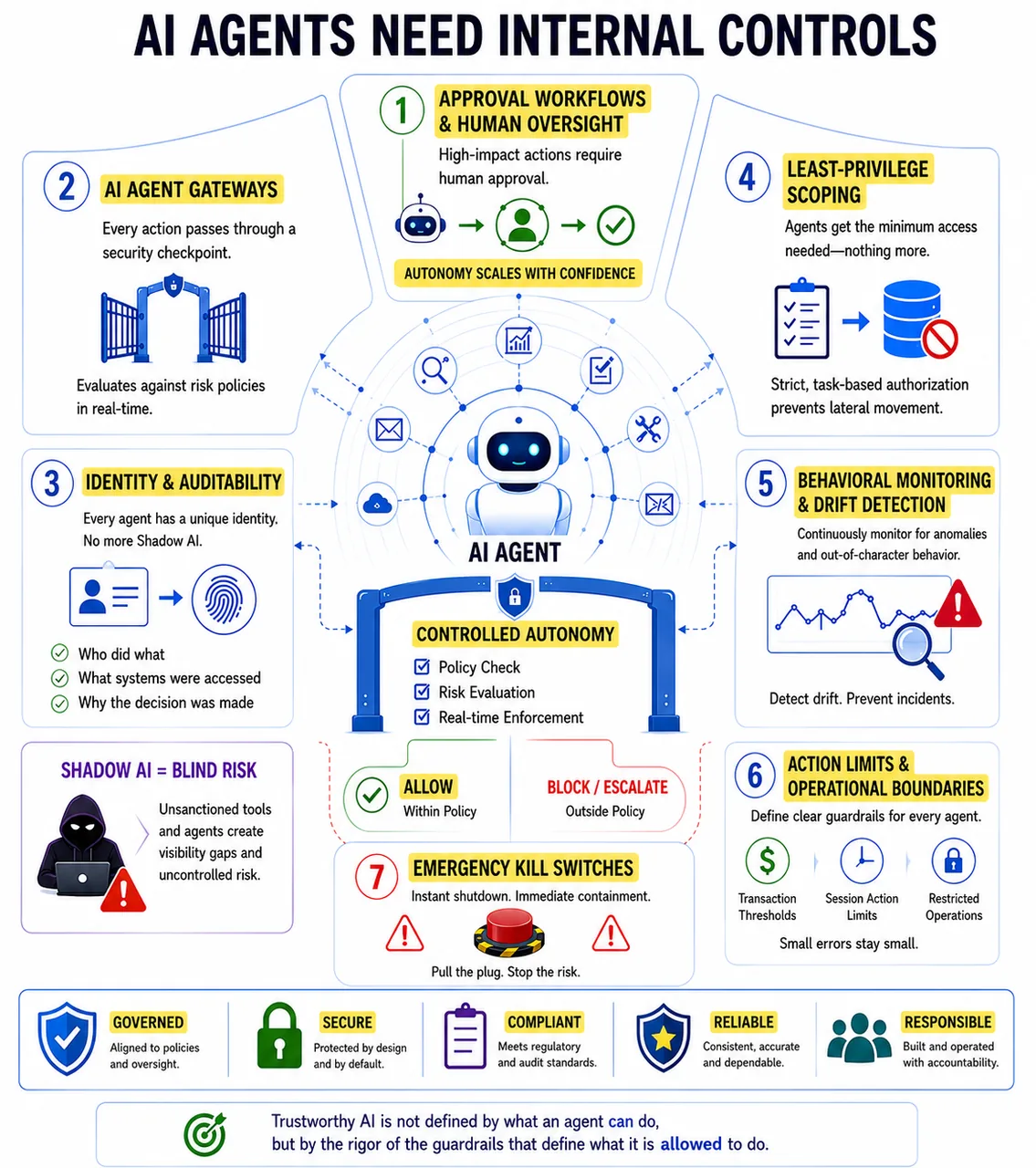
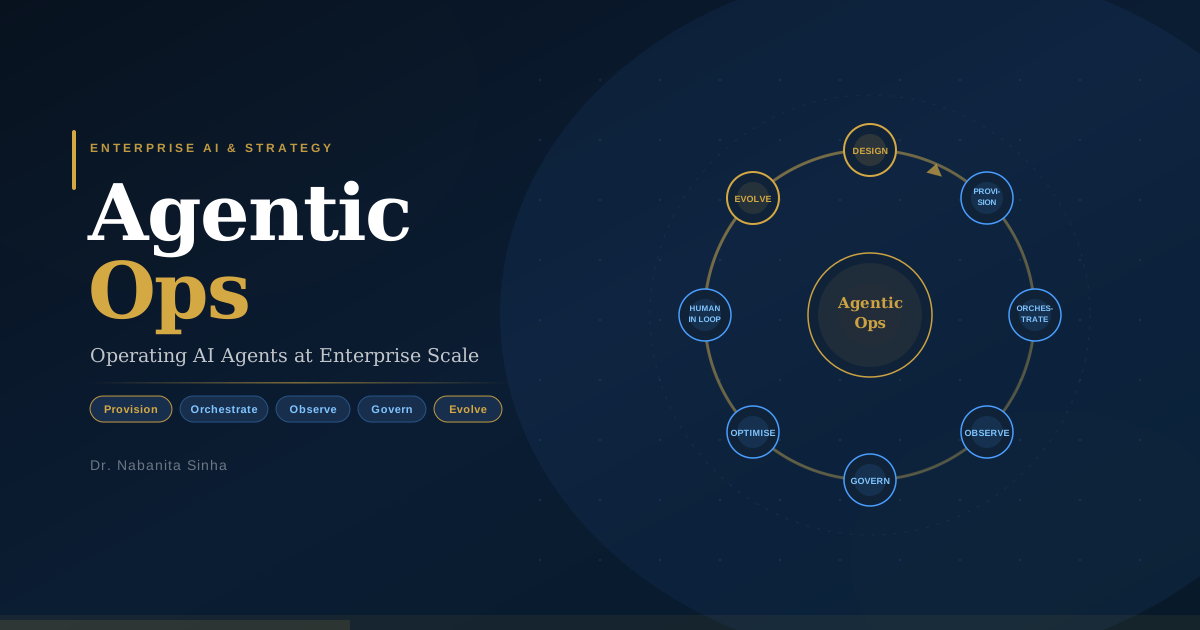
The seven internal controls of a Controlled Autonomy framework — from approval workflows to emergency kill switches.
- Baseline Profiling: At deployment, capture a behavioural baseline — average tool-call count per session, typical reasoning depth, normal escalation rate, standard session duration. This becomes the reference profile.
- Statistical Drift Thresholds: Define alert thresholds as statistical deviations from the baseline (e.g., tool-call frequency exceeding 2σ above baseline triggers an alert). This avoids the brittleness of hard-coded rules while remaining auditable.
- Semantic Drift: Beyond quantitative metrics, evaluate whether the agent's outputs remain semantically aligned with its stated purpose. Embedding-based similarity between current output distributions and baseline outputs can flag agents that are "off-script" before a formal rule violation occurs.
Platforms like Zenity and emerging SIEM integrations are beginning to offer agent-specific runtime analytics. For most enterprise teams, a pragmatic starting point is structured logging of every agent session to a queryable store, combined with scheduled drift analysis jobs.
4. Least-Privilege Scoping
The principle of least privilege — grant only the minimum permissions necessary for a task — is decades old in traditional software security. In agentic AI, it is routinely violated, because the convenience of broad access is real and the blast radius of that choice is not immediately visible.
An agent that can read and write to a financial database when its task only requires reads has been granted unnecessary risk. Operationalising least privilege for agents requires moving from role-based access (which is coarse-grained) to task-based, time-bounded authorisation.
- Task-Scoped Permissions: Access grants should be tied to a specific task context — an agent processing AML alerts should access only the relevant alert queues and transaction lookups, not the full customer data warehouse. When the task session ends, the grant expires.
- Action Thresholds: Define hard operational limits: transaction spending caps (e.g., no single financial action above £5,000 without HITL), session action limits (e.g., maximum 200 write operations per session), and restricted operation lists (e.g., DELETE and DROP operations always require human authorisation regardless of risk score).
- Blast Radius Containment: The goal of least-privilege scoping is not to prevent agents from working — it is to ensure that when something goes wrong (and at scale, something will), the damage is contained to the minimum possible scope.
6. Action Limits & Operational Boundaries
Even a correctly scoped, correctly identified agent can cause significant harm through sheer volume or velocity of actions. Least-privilege scoping tells the agent where it can go; action limits tell it how much it can do when it gets there. These are different controls and both are necessary.
Without operational boundaries, a small technical error — a bug in a loop, a misconfigured trigger, a prompt injection — can escalate into a large business incident before a human has time to intervene. Limits exist to shrink the blast radius of the inevitable.
- Transaction Thresholds: Define absolute spending or commitment limits per action and per session. A procurement agent might be permitted to raise purchase orders up to £5,000 autonomously; anything above triggers a mandatory HITL approval. These thresholds are hard-coded in the gateway layer — not in the agent's prompt, where they can be overridden by a sufficiently crafted input.
- Session Action Limits: Cap the number of write operations, API calls, or external messages an agent can perform in a single session. If an agent is designed to process 10–20 records per session and suddenly attempts 2,000, the limit catches the anomaly before it propagates.
- Restricted Operation Lists: Certain operations — bulk deletes, schema modifications, external data exports, mass communications — should be categorically off-limits for autonomous execution, regardless of the agent's granted role. These are maintained as an explicit blocklist in the authorisation layer.
- Rate Limiting by Time Window: Beyond session caps, enforce time-window limits. An agent that can perform 100 actions per hour is meaningfully different from one that can perform 100 actions per minute. Burst behaviour is often the first signal of a compromised or malfunctioning agent.
The design principle here is "fail small." If a control fails, the resulting incident should be manageable. Action boundaries are the last line of containment before human intervention becomes the only option.
7. Emergency Kill Switches and Incident Response
For any enterprise function operating at meaningful scale, the ability to immediately and completely halt an agent is not optional. This is the operational equivalent of a circuit breaker — a mechanism that prioritises safety over continuity when the two conflict.
- Hard-Coded Suspension: If an agent's behaviour triggers a safety threshold — or if a security team suspects a compromise — the system must support instant, automated access revocation. This means the kill switch is in the identity and authorisation layer, not just the application layer. Revoking the agent's service identity effectively terminates all active sessions and prevents new ones.
- Forensic Preservation: Suspension should trigger automatic preservation of the agent's full session logs, memory state, and decision traces. The goal is not just to stop the agent — it is to enable a complete post-incident investigation.
- Graduated Response: Not all incidents warrant immediate full suspension. Design a graduated response: Alert (log and notify, continue operation), Throttle (reduce action rate, require HITL for high-risk operations), Isolate (revoke external access, continue read-only), Suspend (full termination).
The Core Principle
"Trustworthy AI is defined not by the breadth of an agent's capabilities, but by the rigor of the guardrails that govern its autonomy."
As NIST and regulatory bodies converge on standardised agent identity and security frameworks, enterprises that build these operational controls now will be the ones positioned to scale agentic innovation securely — not the ones reacting to incidents.
The Regulatory Horizon
The governance landscape for AI agents is consolidating rapidly. NIST is actively developing guidance on agent identity and authorisation as an extension of its AI Risk Management Framework. The EU AI Act's provisions on high-risk AI systems effectively mandate audit trails, human oversight mechanisms, and incident reporting for agentic systems operating in regulated sectors.
Enterprises in financial services, healthcare, and critical infrastructure should treat these seven controls not as aspirational best practice, but as near-term compliance requirements. The organisations building Controlled Autonomy architectures today are de-risking their regulatory posture, not just their engineering posture.
Conclusion
The shift from static AI tools to autonomous agents is not a future event — it is already underway in every serious enterprise AI programme. The question is not whether to deploy agents, but whether to deploy them with the governance architecture they require.
Controlled Autonomy — approval workflows, gateways, identity, least-privilege scoping, drift monitoring, action boundaries, and kill switches — provides that architecture. It is not a constraint on agentic capability. It is the foundation that makes agentic capability safe to scale.
References
- 1.Ethyca (2026). AI Governance: Framework, Compliance & Operational Guide.
- 2.Kore.ai (2026). AI agent governance: a practical guide to risk, trust, and compliance.
- 3.Cyber Advisors (2026). Securing AI Agents: Governance Controls for Autonomous Workflows.
- 4.Palo Alto Networks (2026). What Is Shadow AI? How It Happens and What to Do About It.
- 5.Zenity (2026). Runtime AI Analytics: Detect AI Agent Drift Early.
- 6.ElixirData (2026). AI Agent Drift Detection: Monitoring Model & Decision Drift.
- 7.Hogan Lovells (2026). Shaping the future of AI security: NIST seeking input on agent identity & authorization.
- 8.Lab Space (2026). NIST AI Agent Security: Red-Teaming Guidance and Enterprise Compliance.