Reasoning RAG Architecture for Enterprise AI
Standard RAG retrieves and generates. Reasoning RAG thinks, plans, retrieves iteratively, validates its own answers, and explains how it got there. This article breaks down every component of the Reasoning RAG architecture — and why enterprises building high-stakes AI systems need it.
Why Standard RAG Falls Short in the Enterprise
Standard RAG works well for simple, factual queries: "What is our refund policy?" The system retrieves the relevant policy document and the LLM summarises it. Clean, fast, correct.
But enterprise AI is rarely that simple. A compliance analyst asks: "Based on our current AML transaction rules and the FATF guidance updated last quarter, does this customer's behaviour pattern warrant a SAR filing — and if so, which specific provisions apply?" That question requires cross-document reasoning, conflict detection between multiple policy sources, confidence estimation, and a fully auditable answer with source attribution.
Standard RAG fails here because it is a linear pipeline: retrieve once, generate once, done. It has no mechanism to reason about whether the retrieved evidence is sufficient, to detect contradictions between sources, to go back and retrieve more when the initial evidence is incomplete, or to validate that its output is faithful to the source material.
Reasoning RAG is the architectural evolution that addresses all of these gaps. It adds a reasoning layer between retrieval and generation — transforming the system from a document summariser into an analytical engine capable of multi-step inference, self-validation, and explainable conclusions.
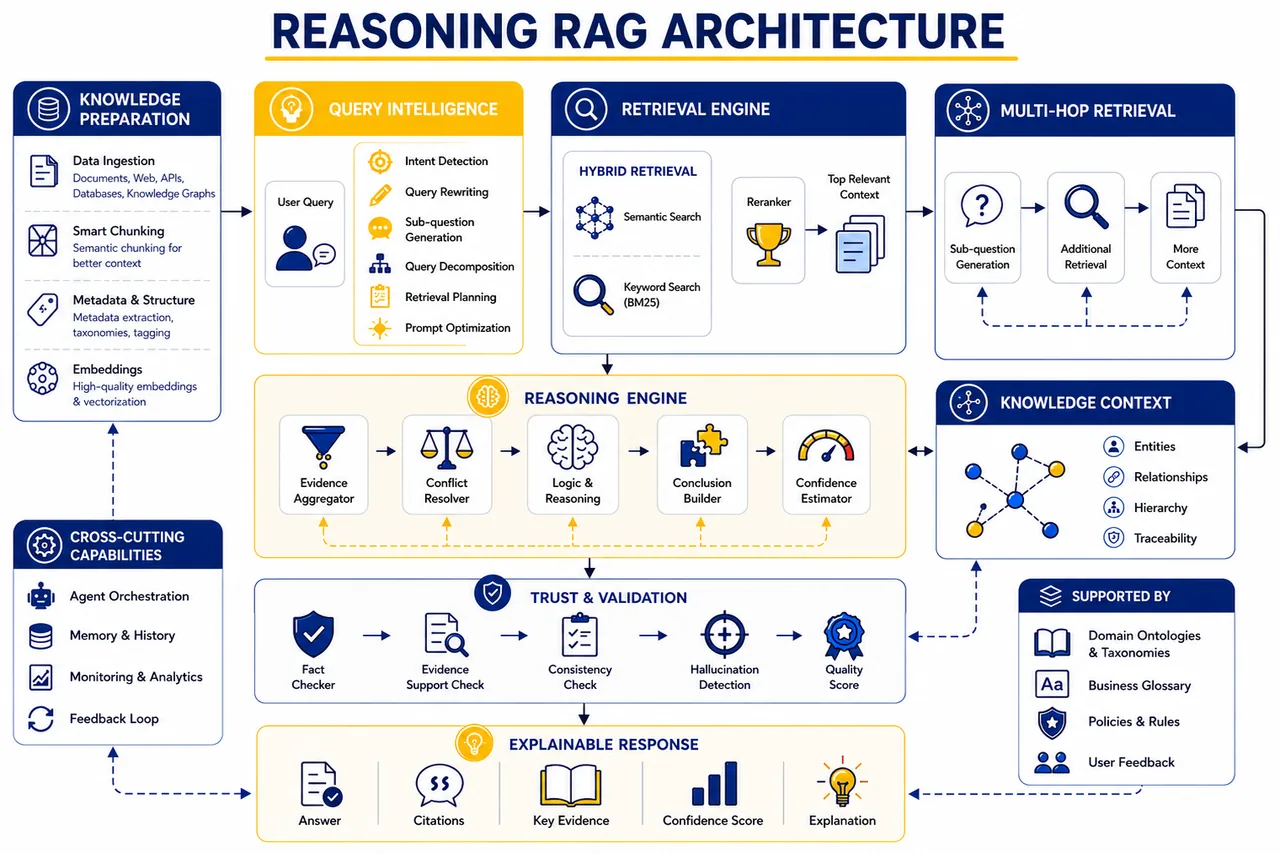
Reasoning RAG Architecture — eight interconnected layers from knowledge preparation to explainable response output.
Reasoning RAG vs. Standard RAG: The Core Difference
| Dimension | Standard RAG | Reasoning RAG |
|---|---|---|
| Workflow | Linear — retrieve once, generate once | Cyclic — think, retrieve, reflect, re-plan |
| Query handling | Single query → single retrieval pass | Decompose → multi-hop iterative retrieval |
| Reasoning | LLM generates from retrieved context | Dedicated reasoning engine: evidence aggregation, conflict resolution, logic |
| Validation | None — output is what LLM generates | Fact check, consistency check, hallucination detection, quality scoring |
| Explainability | No source attribution beyond basic citations | Answer + citations + key evidence + confidence score + reasoning explanation |
| Enterprise fitness | Suitable for simple Q&A, search | Suitable for compliance, audit, complex analysis, regulated decisions |
1 — Knowledge Preparation: Building the Right Foundation
Every Reasoning RAG system is only as good as its knowledge foundation. The Knowledge Preparation layer transforms raw enterprise data — documents, databases, APIs, knowledge graphs — into semantically addressable units that the retrieval engine can work with precisely.
Data Ingestion
InputIngests from all enterprise data sources: PDFs, Word documents, internal wikis, web content, relational databases, APIs, and knowledge graphs. A robust ingestion pipeline handles format conversion, deduplication, version management, and incremental updates — so the knowledge base stays current without full re-indexing.
Smart Chunking
StructureSplitting documents into chunks is not a formatting step — it is a retrieval strategy decision. Semantic chunking detects topic transitions using embedding similarity and splits at meaningful boundaries. Parent-child chunking retrieves small, precise child chunks but passes larger parent chunks to the LLM for context richness. Recursive chunking respects document hierarchy (chapters → sections → paragraphs). Poor chunking is the most common cause of retrieval quality failure.
Metadata & Structure
PrecisionEvery chunk carries structured metadata: source document, section, date, author, document type, applicable jurisdiction, product line, risk category. Metadata is the mechanism that transforms broad similarity search into targeted retrieval — filtering by metadata before vector search dramatically improves precision for enterprise queries like 'regulatory guidance from 2024 only' or 'risk policies for APAC region'.
Embeddings
VectorsHigh-quality embedding models convert text chunks into dense vector representations that capture semantic meaning. General-purpose models (OpenAI text-embedding-3-large, Cohere embed-v3) work well for broad enterprise content. Domain-specific fine-tuned models outperform general models in specialised fields — legal, clinical, financial — where terminology is precise and context-specific.
2 — Query Intelligence: Understanding What Was Really Asked
Raw user queries are rarely retrieval-ready. A compliance analyst who asks "does this transaction profile meet our AML thresholds?" is asking a multi-part question that requires sub-question generation, policy retrieval, threshold comparison, and a structured conclusion. The Query Intelligence layer transforms the raw query into a retrieval-ready plan before a single vector search is run.
Intent Detection
Classifies the query type: factual lookup, comparative analysis, policy compliance check, summarisation, or exploratory research. Intent classification routes the query to the right retrieval strategy — a factual lookup needs precise keyword + vector search; a policy compliance check needs multi-document reasoning.
Query Rewriting
Rephrases the query to improve retrieval recall. Includes HyDE (Hypothetical Document Embeddings) — generating a hypothetical ideal answer and using its embedding for retrieval — which bridges the semantic gap between short queries and long documents. Step-Back Prompting abstracts specific questions to more general principles for broader retrieval.
Sub-question Generation
Decomposes a complex question into atomic sub-questions, each of which can be answered by a focused retrieval pass. 'What are our regulatory obligations for cross-border payments?' becomes: (1) What regulations govern cross-border payments in our jurisdictions? (2) What are our current procedures? (3) What are the gaps?
Query Decomposition
Structures sub-questions into a Directed Acyclic Graph (DAG) — defining dependencies between sub-questions so dependent retrievals wait for parent answers before executing. This prevents circular reasoning and ensures the multi-hop retrieval follows a logically valid sequence.
Retrieval Planning
Selects the optimal retrieval strategy for each sub-question: dense search only, hybrid dense+sparse, metadata-filtered search, knowledge graph traversal, or external API call. The plan is executed by the Retrieval Engine, not improvised at retrieval time.
Prompt Optimisation
DSPy-style prompt compilation optimises instruction framing for each retrieval and reasoning step. Instead of hand-crafted prompts, the system learns (or is programmatically tuned) to maximise retrieval signal and reasoning quality for its specific domain.
3 — Retrieval Engine: Hybrid Search + Reranking
The Retrieval Engine executes the retrieval plan produced by Query Intelligence. At its core is Hybrid Retrieval — combining two fundamentally different search mechanisms whose strengths are complementary.
- Semantic Search (Dense Retrieval): Vector similarity search using embedding representations. Excellent at finding conceptually related content even when the exact wording differs — "regulatory obligations" retrieves "compliance requirements". Fast at scale with Approximate Nearest Neighbour (ANN) indexes (HNSW). Weakness: misses exact matches for technical codes, product names, and regulatory clause numbers.
- Keyword Search / BM25 (Sparse Retrieval): TF-IDF-based term frequency scoring. Precise for exact terminology — critical in enterprise contexts where "Regulation (EU) 2016/679 Article 17" is not the same as "GDPR right to erasure". Weaknesses: no semantic understanding, sensitive to vocabulary mismatch.
- Reciprocal Rank Fusion (RRF): The standard mechanism for combining dense and sparse results. RRF assigns each result a score based on its rank in each individual result list, then sums the scores. Simple, parameter-free, consistently outperforms weighted sum fusion in practice.
Reranking: The Precision Amplifier
The initial hybrid retrieval returns the top-k candidates by approximate relevance. Reranking applies a second, higher-precision scoring pass using a Cross-Encoder — a model that scores each candidate by reading the query and document together (not just their independent embeddings). Cross-encoders are slower but significantly more accurate, catching relevance nuances that embedding models miss.
Common cross-encoder models: Cohere Rerank (API), BGE-reranker (open source), Jina ColBERT. A typical retrieval pipeline retrieves top-50 candidates from hybrid search, then reranks to top-5 for the reasoning engine. The quality of these top-5 chunks is the single biggest determinant of reasoning quality.
4 — Multi-Hop Retrieval: Following the Evidence Trail
Many enterprise questions cannot be answered from a single retrieval pass. A risk assessment query may require cross-referencing a transaction record, a customer risk profile, an internal policy document, and an external regulatory guideline — each retrieved separately, each informing what to retrieve next.
Multi-Hop Retrieval implements an iterative Retrieve → Reflect → Re-retrieve loop:
The Reasoning Engine acts as the director of this loop — after reviewing the results of the first retrieval pass, it decides whether additional evidence is needed before forming a conclusion. If the initial evidence is incomplete, contradictory, or covers only part of the question, it generates additional sub-questions and triggers further retrieval.
This is the architectural pattern that enables enterprise use cases like AML alert investigation (follow transaction chains across multiple records), regulatory gap analysis (cross-reference current procedures against updated regulations from multiple jurisdictions), and clinical research synthesis (aggregate findings across multiple studies with conflicting results).
In practice, most queries require 2–4 retrieval hops. The system enforces a maximum hop limit to prevent infinite loops, and the Reasoning Engine can terminate early if confidence is high and evidence is consistent.
5 — Reasoning Engine: Where Thinking Happens
The Reasoning Engine is the architectural innovation that distinguishes Reasoning RAG from all prior RAG variants. It is a structured reasoning pipeline — not just an LLM prompt — that processes the aggregated evidence from all retrieval hops and produces a validated conclusion.
Evidence Aggregator
Collects all retrieved chunks from all retrieval hops and organises them into a structured evidence set — grouped by sub-question, ranked by relevance score, tagged with provenance metadata (source, date, authority). The aggregator deduplicates overlapping content and identifies which sub-questions have strong evidence coverage vs. which are under-evidenced (triggering additional retrieval if needed).
Conflict Resolver
Enterprise knowledge bases contain contradictions — an internal policy that predates a regulatory update, a guideline that differs between jurisdictions, or two analysts' notes that interpret a rule differently. The Conflict Resolver detects semantic contradictions between evidence chunks and applies resolution strategies: recency weighting (newer source wins), authority weighting (regulatory text outranks internal interpretation), or explicit conflict flagging that surfaces contradictions in the final response for human review.
Logic & Reasoning
The core inference step — the LLM applies Chain-of-Thought (CoT) reasoning over the conflict-resolved evidence set to build a structured argument. For complex queries, Tree-of-Thought (ToT) explores multiple reasoning branches in parallel before selecting the most internally consistent path. The reasoning step produces an explicit inference trace: each logical step is documented, connected to its evidence, and preserved for the explainability layer.
Conclusion Builder
Synthesises the inference trace into a structured conclusion object — not raw LLM text, but a typed data structure containing: the primary answer, a supporting argument summary, the evidence items used, any unresolved conflicts or gaps, and preliminary confidence indicators. This structured output is what the Trust & Validation layer operates on.
Confidence Estimator
Produces a multi-dimensional confidence score reflecting: (a) evidence coverage — how well the retrieved evidence covers the question; (b) evidence consistency — whether sources agree; (c) reasoning depth — how many inferential steps were required; (d) source authority — the quality and recency of source materials. Low confidence scores trigger either additional retrieval passes or HITL escalation, preventing the system from presenting uncertain outputs with false certainty.
6 — Knowledge Context: The Graph Behind the Vectors
Vector stores are powerful for similarity-based retrieval, but they are inherently flat — they cannot represent the relationships between entities. A pharmaceutical company's knowledge base contains not just documents about drug compounds, but relationships between compounds, indications, contraindications, clinical trial results, and regulatory approvals. A flat vector store can retrieve relevant documents, but a knowledge graph can answer: "What are all the compounds with similar mechanisms to Drug X that have been approved in the EU since 2022?"
The Knowledge Context layer adds a structured knowledge graph to the retrieval substrate, providing four capabilities that vector stores alone cannot:
- Entities: Named, typed objects — drugs, regulations, customers, products, jurisdictions, risk events — indexed by identifier, not just embedding similarity.
- Relationships: Directed, typed connections between entities — "regulation X supersedes regulation Y", "customer A is associated with entity B through transaction C". Relationship traversal enables queries that require following explicit connections, not inferring them from semantic similarity.
- Hierarchy: Parent-child and part-of relationships — a regulation contains articles, articles contain clauses, clauses contain obligations. Hierarchical traversal enables precise clause-level retrieval that flat chunking loses.
- Traceability: Every entity and relationship is traceable to its source — the document, date, and authority that established it. This is the audit trail that regulated industries require.
In practice, the most effective Reasoning RAG implementations use a hybrid retrieval substrate: vector search for semantic similarity, knowledge graph traversal for relationship-based queries, and metadata filtering for structured constraints — with the Query Intelligence layer routing each sub-question to the most appropriate retrieval mechanism.
7 — Trust & Validation: Checking the Work
In high-stakes enterprise contexts — regulatory compliance, risk decisions, clinical guidance — an AI answer that is confident but wrong is worse than no answer at all. The Trust & Validation layer is the quality gate that runs between the Reasoning Engine and the final response, systematically checking the reasoning output before it reaches the user.
| Validation Check | What It Tests | Failure Action |
|---|---|---|
| Fact Checker | Every factual claim in the conclusion is traceable to a specific retrieved chunk. Uses NLI (Natural Language Inference) models to classify whether each claim is entailed, contradicted, or neutral with respect to its cited source. | Flag unsupported claims; optionally trigger additional retrieval to find supporting evidence |
| Evidence Support Check | Verifies that the evidence cited actually supports the conclusion — not just that it is topically related. LLM-as-judge scoring with the prompt: 'Does this evidence directly support this claim?' | Downgrade confidence score; flag specific unsupported reasoning steps |
| Consistency Check | Checks internal logical consistency — the conclusion should not simultaneously assert and contradict the same proposition. Also checks that the answer is consistent with prior answers in the same session (session-level coherence). | Flag contradictions; surface them explicitly in the response for human review |
| Hallucination Detection | The most critical check for enterprise use. Identifies text in the generated conclusion that has no grounding in retrieved evidence — phrases, numbers, citations, or claims that the LLM generated from parametric memory rather than retrieved context. | Remove or clearly mark ungrounded claims; reduce confidence score significantly |
| Quality Score | Composite score combining evidence coverage, claim support, consistency, and hallucination absence. The score determines response handling: high-quality responses are returned directly; borderline responses include uncertainty disclosures; low-quality responses are escalated to HITL review. | Route to human review queue with full evidence trace for reviewer |
The Trust & Validation layer is powered by a combination of automated checks (NLI models, embedding similarity between claims and evidence) and LLM-as-judge evaluation (GPT-4 or Claude scoring specific aspects of quality). Tools like RAGAS, TruLens, and DeepEval provide framework-level support for these evaluations.
8 — Explainable Response: Answers You Can Audit
The final output of a Reasoning RAG system is not just an answer — it is an explainable response package containing everything a human reviewer needs to verify, audit, or challenge the conclusion. This is the component that makes Reasoning RAG viable for regulated industries.
Answer
The primary response — concise, structured, calibrated to the question type. Not a raw LLM paragraph but a typed response object with defined fields.
Citations
Every claim links to its source: document name, section, page, and the exact text excerpt that grounds the claim. Citations are machine-readable, not just inline text references.
Key Evidence
The 3–5 most critical evidence items that drove the conclusion — surfaced explicitly so reviewers can focus their attention, rather than reading the full retrieved context.
Confidence Score
Multi-dimensional score (evidence coverage, consistency, hallucination absence) rendered as a calibrated percentage. Sub-scores for each dimension allow reviewers to understand what is and isn't well-supported.
Explanation
A plain-language reasoning summary: 'I concluded X because evidence A and B both indicate Y, while evidence C was inconsistent with the conclusion but was superseded by the more recent document D.' Designed for both technical reviewers and business stakeholders.
This explainability package is not optional for enterprise deployment — it is the mechanism through which Reasoning RAG earns and maintains user trust. When a compliance officer can see exactly why the system reached a conclusion and which documents it relied on, they can verify the reasoning, identify edge cases, and make informed decisions about when to accept or override the AI's recommendation.
9 — Cross-Cutting Capabilities: The Operational Substrate
Running across all eight layers are four operational capabilities that the architecture diagram shows as a vertical bar — they are not a layer, they are a substrate that all other layers depend on:
- Agent Orchestration: The multi-step reasoning process — decompose, retrieve, reason, validate, respond — is managed by an orchestration framework. LangGraph (stateful graph execution) is the most production-mature choice for Reasoning RAG, as its explicit state management and conditional branching directly model the retrieve-reflect-re-retrieve loop.
- Memory & History: Cross-session memory preserves the context of ongoing analytical work — useful for long-running investigations where a compliance analyst returns to a case over multiple sessions. Short-term working memory within a session enables the Reasoning Engine to reference earlier findings when processing later sub-questions.
- Monitoring & Analytics: Instrumentation across every component — retrieval latency, chunk relevance distributions, reasoning step counts, validation pass rates, confidence score distributions, and HITL escalation rates. These metrics surface both operational health and quality signals for continuous improvement.
- Feedback Loop: Human reviewer decisions (accept, reject, override, flag) are captured and fed back as quality signals. Over time, this enables active learning — improving retrieval quality, adjusting confidence thresholds, and identifying systematic gaps in the knowledge base that require additional document ingestion.
10 — Enterprise Knowledge Infrastructure: Supported By
The right side of the architecture diagram shows four enterprise knowledge assets that the entire system is grounded in. These are not optional add-ons — they are what separates an enterprise Reasoning RAG deployment from a generic one:
Domain Ontologies & Taxonomies
Formal representations of concepts and their relationships within the enterprise domain. In financial services: a regulatory ontology maps relationships between regulations, obligations, and business processes. Ontologies enable the knowledge graph to reason about concept relationships, not just keyword similarity.
Business Glossary
Canonical definitions of enterprise terms — ensuring that 'customer risk score', 'exposure limit', and 'suspicious activity' mean the same thing across all documents, systems, and regulatory filings. Query Intelligence uses the business glossary for query rewriting and disambiguation.
Policies & Rules
Machine-readable policy rules that the Reasoning Engine can evaluate programmatically. Rather than retrieving policy documents and asking the LLM to interpret them, structured policy rules enable deterministic evaluation of specific conditions — critical for compliance decisions that must be consistent and auditable.
User Feedback
Structured feedback from domain experts — corrections to reasoning errors, additions to the knowledge base, flagged hallucinations, and reviewer override decisions. Feedback is the primary mechanism for continuous quality improvement and for detecting systematic failure modes before they cause business impact.
Where Reasoning RAG Delivers Enterprise Value
The full architectural complexity of Reasoning RAG is justified when the query type requires multi-document reasoning, auditability, or high-accuracy validation. The highest-value enterprise use cases are:
Regulatory Compliance & Gap Analysis
Financial ServicesCross-reference current procedures against updated regulations across multiple jurisdictions. Detect policy gaps, generate evidence-backed compliance assessments, and produce auditable reports that show exactly which regulatory clauses each finding relates to.
AML / Financial Crime Investigation
BankingMulti-hop reasoning across transaction records, customer risk profiles, network relationships, and regulatory thresholds. Produces SAR-ready evidence packages with full citation trails — reducing analyst time from hours to minutes while improving consistency.
Clinical Research Synthesis
Life SciencesAggregate findings across clinical trial reports, drug interaction databases, and regulatory submissions. Detect conflicting study results, surface confidence levels, and generate structured evidence summaries for regulatory submissions.
Enterprise Knowledge Q&A with Audit
All IndustriesComplex policy and procedure queries from employees, customers, or auditors that require accurate, traceable answers — not hallucinated summaries. Confidence scores and citation trails make answers auditable and defensible.
Contract & Due Diligence Analysis
Legal / M&AMulti-hop analysis across contract documents, precedent cases, regulatory filings, and risk disclosures. Identifies conflicting clauses, missing obligations, and risk exposures with full evidence attribution.
The Enterprise Principle
"Enterprise AI that cannot explain its reasoning, cite its evidence, or quantify its confidence is not enterprise-ready — it is a liability."
Conclusion
Reasoning RAG moves enterprise AI from document summarisation to genuine analytical reasoning — multi-hop retrieval, conflict resolution, self-validation, and fully auditable outputs. For regulated industries, this architecture is not over-engineering. It is the minimum viable design for AI that can be trusted with consequential decisions.
References & Further Reading
- [1]Lewis et al. Retrieval-Augmented Generation for Knowledge-Intensive NLP Tasks. NeurIPS 2020.
- [2]Gao et al. Retrieval-Augmented Generation for Large Language Models: A Survey. arXiv:2312.10997, 2023.
- [3]Trivedi et al. Interleaving Retrieval with Chain-of-Thought Reasoning for Knowledge-Intensive Multi-Step Questions. ACL 2023.
- [4]Asai et al. Self-RAG: Learning to Retrieve, Generate, and Critique through Self-Reflection. ICLR 2024.
- [5]Es et al. RAGAS: Automated Evaluation of Retrieval-Augmented Generation. arXiv:2309.15217, 2023.