Enterprise AI & Strategy
AI Governance Is an Operating System, Not a Policy Document
A practical method for taking an AI project from an interesting idea to a system someone can responsibly own, approve, and stop.
Imagine a customer-service team using AI to draft replies. The prototype is impressive. It answers quickly, sounds empathetic, and knows the product catalogue. Then it cites a retired refund policy, includes details from another customer's case, and sends a reply before an agent can review it. Which team owns the incident: product, data, security, or operations?
That question is the beginning of AI governance. It is not an abstract debate about whether AI is good or bad. It is the work of deciding what a system is allowed to do, under what conditions, with what evidence, and who has authority when the answer is not yet. Good governance lets an organization move faster on sound ideas because it makes uncertainty visible before the system becomes somebody else's problem.
What AI governance actually is
AI governance is the set of policies, roles, decision rights, processes, and records by which an organization directs and oversees its AI systems. A policy may say that sensitive customer data cannot be sent to an unapproved service. Governance names who classifies that data, who approves an exception, where the decision is recorded, and when it must be revisited. It operates from the first use-case proposal through procurement, development, deployment, change, and retirement.
It is important to separate three related disciplines. Governance establishes accountability and the evidence required to make decisions. Technical controls implement particular safeguards: access restrictions, evaluations, logging, rate limits, redaction, or human-review queues. Legal compliance determines which laws and contractual duties apply in a particular context and whether they have been met. A security filter is not a governance program; a signed policy is not proof that the filter works; adopting a framework is not a certificate of legal compliance.
The voluntary NIST AI Risk Management Framework gives teams a helpful common vocabulary: Govern, Map, Measure, Manage. Govern is a cross-cutting function; the others guide teams to understand context, assess risks, and act on them. The framework is adaptable, not a one-size-fits-all checklist. For generative systems, NIST's Generative AI Profile extends that conversation to risks associated with generative AI. Neither replaces a use-case-specific assessment.
The practical test
Can you show who approved this use, what they knew at the time, what would make them change their mind, and how the system would be stopped?
Why governance is a must, not an optional committee
AI changes the economics of producing decisions and content. A single integration can place a model in front of thousands of users or give it access to sensitive records. Its behavior can also change when the model, prompt, retrieval corpus, vendor, or surrounding workflow changes. The risks are not confined to accuracy. A useful-sounding answer may be unfair to a group, expose private information, fail under unfamiliar inputs, or be manipulated into taking an unauthorized action.
Without governance, these issues are discovered as local surprises: a product manager assumes a model is merely drafting, engineering assumes a human is reviewing, and operations assumes security approved the data flow. A shared operating model forces those assumptions into the open. It also protects investment. Teams should not spend months tuning a system only to learn that no one can establish its data provenance, define acceptable performance, or support it after launch.
The requirement is proportionality, not bureaucracy for its own sake. An internal brainstorming assistant and an AI system used in a consequential decision should not pass through identical gates. Both need an owner and a defined purpose. The second needs deeper evidence, more independent challenge, stronger oversight, and a more formal release decision. Start with the potential impact on people, the sensitivity of data, autonomy, scale, reversibility, and the ease of detecting harm. Reassess if any of those change.
Some contexts also carry binding duties. For example, the EU AI Act sets requirements for systems that fall into its high-risk regime; its Article 9 addresses risk management for high-risk AI systems, while Article 26 addresses obligations of their deployers. Provider and deployer responsibilities are not interchangeable. Applicability depends on the system, role, jurisdiction, and risk classification; legal counsel should determine obligations rather than a generic template. Governance gives that determination a place in the project record.
A repeatable operating loop for any AI project
The following loop works whether you are buying a model API, fine-tuning a classifier, deploying a retrieval-augmented assistant, or adding an agent to an existing process. The depth of each step changes with risk; the questions do not. Each gate should end with a recorded decision: proceed, proceed with conditions, redesign, or stop. An unaddressed red flag is not a fifth option.
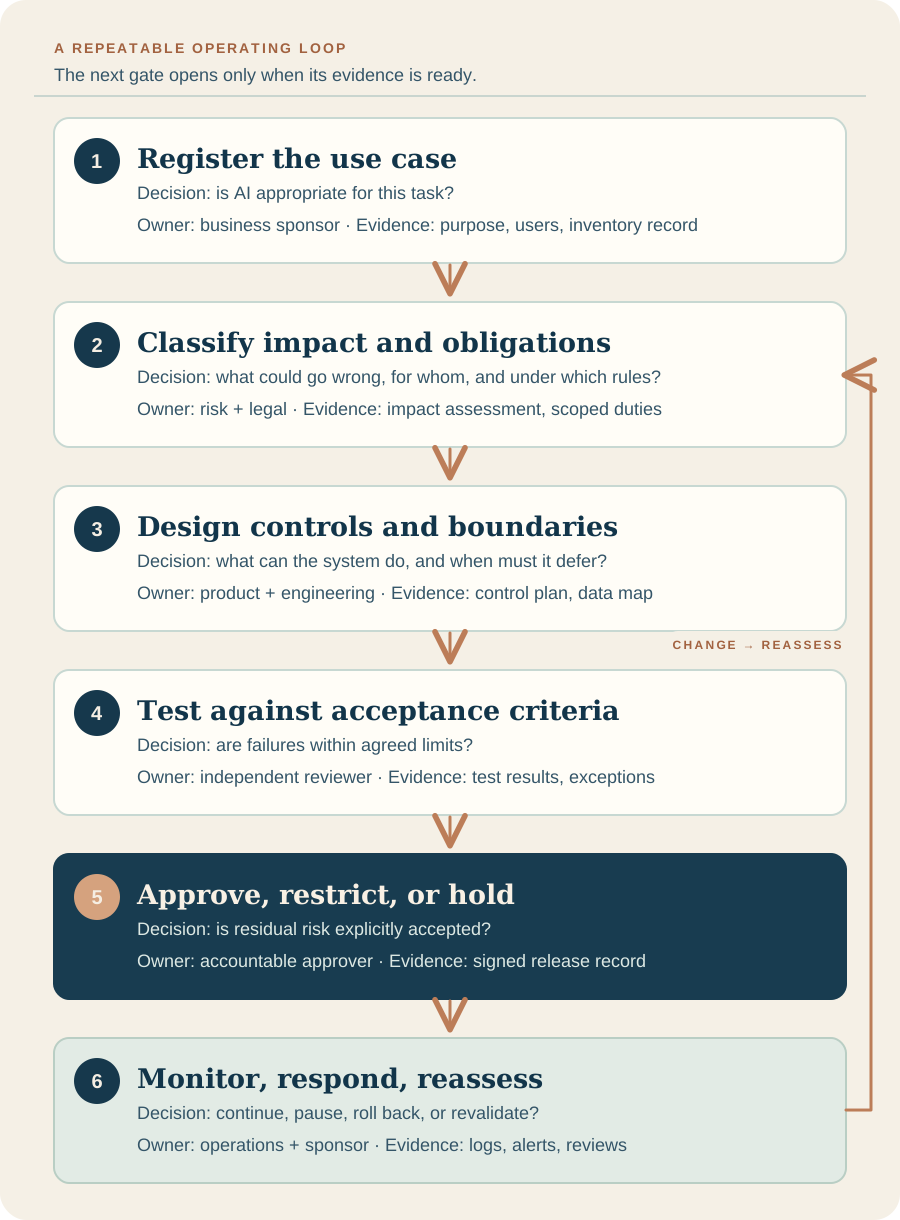
Gate 1 — Register the use case, not just the model
The business sponsor writes a one-page account of the intended task, users, affected people, expected benefit, and alternatives. What decision will the system inform or make? Will its output be advice, a draft, a recommendation, or an action? What is explicitly out of scope? Add the model or vendor, connected tools, data sources, and deployment environment to a living inventory. An inventory entry is not paperwork: it is how operations later discovers which systems use a compromised dependency or a retired data source.
Evidence: use-case record and system boundary diagram. Decision: is AI an appropriate means to this end? If a deterministic rule can do the job more reliably, use the rule. Do not let the attractiveness of a demo become the justification for a production system.
Gate 2 — Classify impact and map obligations
Bring the sponsor, risk lead, privacy and security specialists, and legal counsel together early. Ask whom a failure could affect, how serious and reversible it would be, whether the system touches personal or confidential data, and what it could do without a person's confirmation. Note vendor and geographic dependencies. Record applicable policies, contracts, and legal duties with the reasoning for inclusion or exclusion. Risk classification is a justified judgment, not a colorful label in a spreadsheet.
Evidence: impact assessment, data-flow map, and scoped obligations register. Decision: what level of validation and sign-off does this use warrant? If the intended use or role under a law is unclear, pause that part of the project for expert review rather than claiming a framework makes it compliant.
Gate 3 — Design controls around real failure modes
Translate risks into design requirements. Privacy: minimize data sent to the model, establish retention and access rules, and test for unintended disclosure. Fairness: identify relevant populations and evaluate whether errors or service quality differ in ways that matter to the use. Robustness: test missing, noisy, changing, and adversarial inputs, not only happy paths. Security: constrain tool permissions, isolate sensitive sources, and test prompt injection where untrusted content enters the system. Human oversight: state which outputs require review and give reviewers the context and authority to reject them.
These controls must live at the right layer. A prompt saying “do not send email” is weaker than removing send permission from a drafting assistant. A human approval button is meaningless if people cannot inspect the source or if a downstream automation bypasses the queue. Document the fallback: what happens when the retrieval service fails, a threshold is crossed, or the reviewer is unavailable?
Evidence: control plan, architecture, permissions, and review design. Decision: can the team test each important safeguard, and is there a safe failure mode?
Gate 4 — Measure before claiming readiness
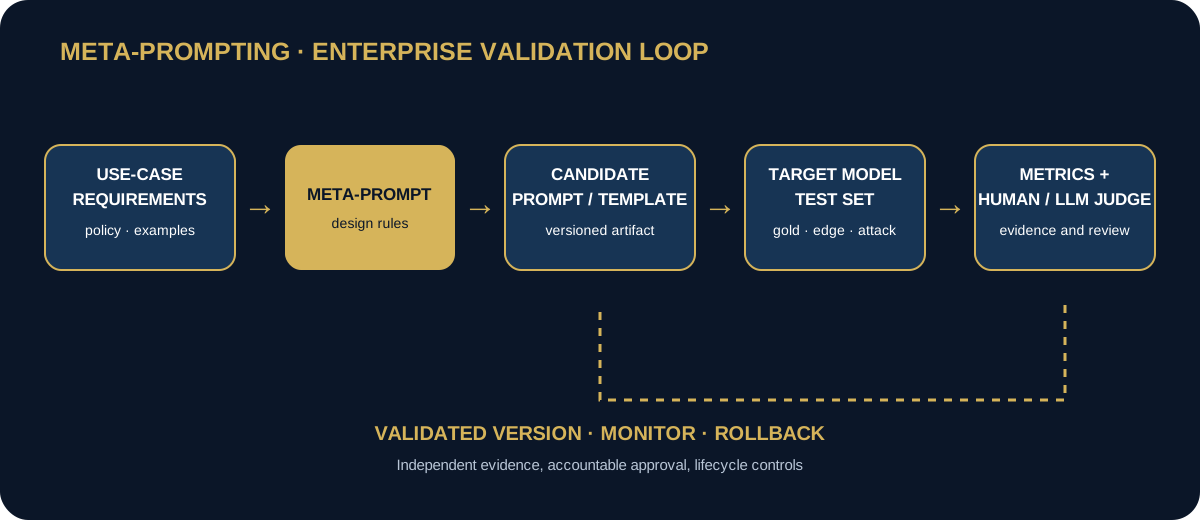
Agree acceptance criteria before looking at the final test results. Build evaluations that resemble the actual operating environment: representative cases, known difficult cases, vulnerable groups where relevant, stale documents, ambiguous requests, and hostile inputs. Record the sample construction, test versions, failed cases, and who reviewed them. Compare against the current human or non-AI process, not against the impossible standard of flawless output in isolation.
A developer should not be the only judge of a consequential system. An independent reviewer—risk, quality, domain, or security depending on the use—checks methods and residual gaps. Model Cards can help document intended uses, limitations, and evaluation; Datasheets for Datasets prompt useful questions about data origin and composition. They make evidence easier to inspect; completing either document does not by itself validate a system.
Evidence: evaluation protocol, test results, exception log, and reviewer finding. Decision: do results meet the criteria for this use, or must scope and controls change?
Gate 5 — Make the release decision explicit
A named accountable approver reviews the use-case record, risk assessment, controls, test findings, outstanding exceptions, and operational plan. They may approve a restricted pilot rather than a general release: limited users, reduced capabilities, mandatory review, and an expiry date for the exception. The approval record should say what was accepted, why, by whom, and when the decision expires. “The team felt comfortable” is not a decision trail.
Separate duties where the stakes justify it. Engineering owns implementation and remediation; the business sponsor owns the value proposition and business consequences; independent risk or assurance challenges the evidence; an authorized release owner accepts residual risk. Legal advises on applicable obligations but should not be made the default owner of model behavior.
Gate 6 — Monitor, intervene, and revisit
Release starts a new phase of evidence. Track outcomes relevant to the use: error and correction patterns, harmful or privacy-related incidents, human overrides, unsupported answers, escalation rates, data quality, availability, and changes in use. Set alert thresholds and review cadence in proportion to impact. Retain logs that help reconstruct what happened while minimizing sensitive data and respecting retention rules. A dashboard without someone on call is decoration.
Give operations a tested response path: pause automated actions, fall back to a human or non-AI process, roll back the model, prompt, or retrieval version, and notify the right owners. Preserve the evidence needed to investigate. Define triggers for reapproval: a new vendor model, new geography, new data category, new user group, expanded autonomy, or a sustained failure pattern. Retirement also needs an owner for access removal, retained records, and downstream dependencies.
Worked example: a customer-support answer assistant
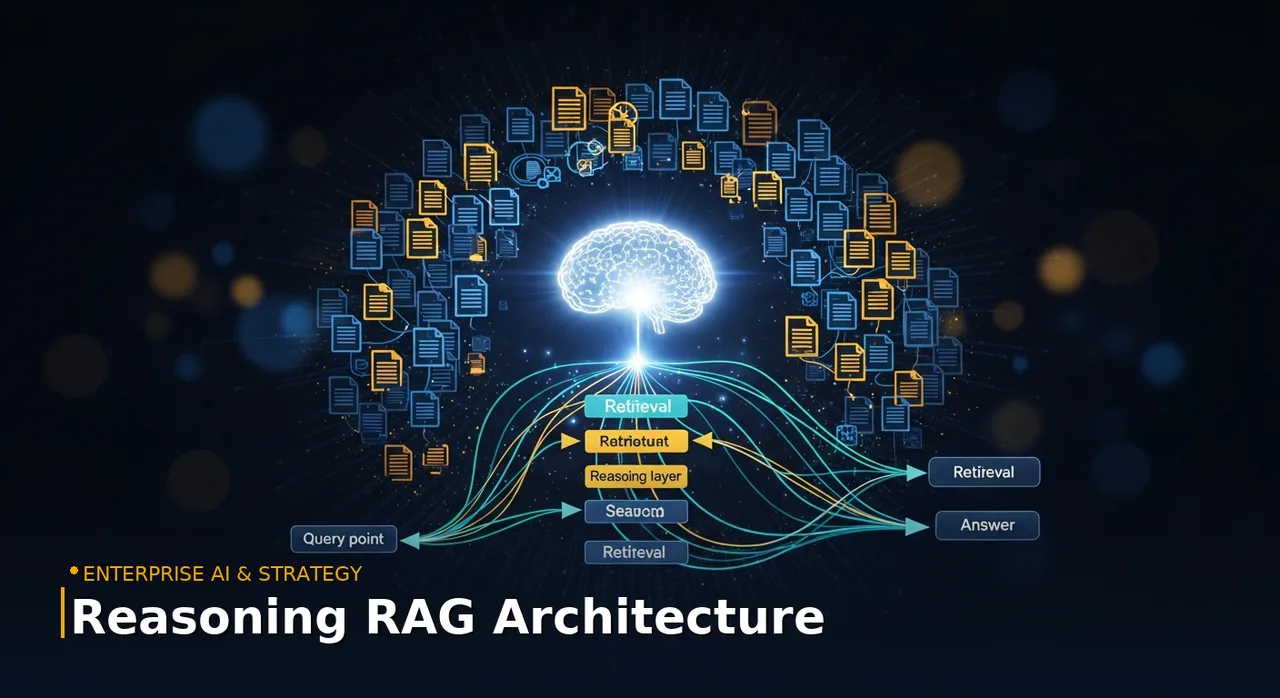
Consider a retailer building a retrieval-augmented assistant to help support agents answer questions about returns. It retrieves approved policy documents and drafts a response with citations. It does not send messages or change orders. The sponsor is the head of customer operations; a product lead coordinates delivery; engineering owns the pipeline; security and privacy review data flows; a support quality lead independently reviews evaluation cases.
At registration, the team states the permitted use: draft answers for trained agents during live chats. Out of scope are legal disputes, fraud cases, and discretionary compensation. The inventory captures the model endpoint, retrieval index, policy repository, logging service, and agent interface. At classification, the team recognizes the risks: customer details may enter a prompt, old policies may be retrieved, and a plausible wrong answer could create a financial commitment. Legal and privacy specialists assess the particular jurisdictions, contracts, and data practices; the team does not assume every AI law applies simply because a model is present.
In design, customer identifiers are minimized before model calls; the retriever searches only current, approved policy versions; each draft displays a source link and policy effective date. The assistant is read-only, and an agent must approve or rewrite every reply. When the source is missing, contradictory, or superseded, the assistant returns “no supported draft” and routes the case to a supervisor. Security tests whether a malicious paragraph inside a retrieved document can make the assistant ignore its instructions or reveal unrelated records.
At validation, the quality lead prepares cases from real support patterns with sensitive details removed, alongside expired-policy traps, ambiguous exceptions, and adversarial documents. Reviewers examine citation support, policy correctness, leakage, and whether the system declines when it should. They record failures and decide which are release-blocking. A model card-like summary states intended use, evaluated conditions, and limitations; a dataset record explains where test cases came from. The team fixes an outdated-policy retrieval bug and reruns the affected cases rather than averaging the bug away in an overall score.
At release, the sponsor approves a limited pilot only after the independent reviewer signs off on the test evidence and operations accepts the escalation path. The approval states that drafts remain agent-reviewed and sending remains disabled. In production, operations samples drafts, tracks agent corrections and unsupported citations, and watches for spikes after policy updates. If a wrong policy enters the index, the on-call owner disables generation, routes agents to the existing knowledge-base workflow, restores the prior approved index, and logs the incident. A future proposal to auto-send replies is a new risk decision, not a minor feature flag.
Notice what this example does not demand: a large committee meeting for every prompt change. The project has pre-agreed change thresholds. Routine copy edits within an approved boundary can receive lightweight review; changes to source access, model, autonomy, or intended users trigger reassessment. Governance is useful precisely when it tells a team which decisions are routine and which are not.
How industry is putting it into practice
No single framework “does governance” for an organization. Teams usually combine a management structure, a risk method, domain-specific tests, and a legal applicability review. ISO/IEC 42001 describes requirements for an organizational AI management system: a way to establish, implement, maintain, and improve how AI is managed. It is not a universal legal mandate, and certification to a management-system standard is not a blanket determination of regulatory compliance.
The OECD AI Principles, adopted in 2019 and updated in 2024, supply a values-level compass for trustworthy AI. NIST AI RMF translates risk thinking into lifecycle activities. Singapore's AI Verify toolkit offers practical testing and reporting support. These are complementary aids, not substitutes for knowing your own system and jurisdiction.
Large technology organizations show different parts of the operating model. Microsoft describes six responsible AI principles and a Responsible AI Standard intended to turn them into practices. Google's Secure AI Framework focuses on AI-specific security risks across the lifecycle. Neither company's published approach can simply be pasted into another organization; the useful lesson is to translate high-level commitments into assigned work, tests, and escalation paths.
The strongest organizations are not the ones with the thickest policy binder. They are the ones where a product team can answer, without improvising: Who owns this use? What evidence cleared it? What changed since approval? Who can stop it today? If those answers are traceable, governance has become part of the work rather than a document about the work.
Take this to your next project review
Name the owner. Define the boundary. Agree the evidence. Set the stop condition.
Everything else becomes easier to challenge, improve, and trust when those four answers are visible.
Further reading
References
- 01NIST, AI Risk Management Framework 1.0
Voluntary framework; Govern, Map, Measure, Manage.
- 02NIST, Generative AI Profile
Companion profile for generative AI risks and actions.
- 03ISO, ISO/IEC 42001
Requirements for an organizational AI management system.
- 04European Commission, EU AI Act Article 9
Risk management for high-risk AI systems.
- 05European Commission, EU AI Act Article 26
Obligations of deployers of high-risk AI systems.
- 06OECD, AI Principles
Adopted in 2019 and updated in 2024.
- 07AI Verify Foundation, AI Verify toolkit
Practical testing and documentation support.
- 08Microsoft, Responsible AI principles and approach
Six principles and a Responsible AI Standard.
- 09Google, Secure AI Framework (SAIF)
Security-oriented framework across the AI lifecycle.
- 10Mitchell et al., Model Cards for Model Reporting
A reporting format for intended use and evaluation.
- 11Gebru et al., Datasheets for Datasets
Documentation questions for dataset provenance and use.