Why Loop Engineering Matters Now
Until recently, deploying an AI agent meant watching it closely — reading every response, nudging it with the next prompt, catching mistakes before they compounded. The agent did the reasoning; the engineer held the guardrails by hand. It worked, but it did not scale.
Loop engineering is the practice of replacing that human-in-every-turn pattern with a designed system. Instead of you deciding when the agent retries, when it stops, and whether the output is good enough, a loop does that work. The agent runs inside a structure that observes what it produces, checks whether the result meets a criterion, and re-runs it if not — up to a defined limit.
The term crystallised in June 2026, building on a progression of disciplines: prompt engineering told us what to say to the model; context engineering told us what information to give it; harness engineering gave us the test infrastructure to validate it; loop engineering now tells us how to orchestrate it over time, without constant supervision.
The progression in one line
Prompt → Context → Harness → Loop
Each layer builds on the last. You cannot build reliable loops without evaluation harnesses. You cannot build harnesses without well-engineered context. But once all four are in place, you have autonomous AI that earns trust in regulated environments.
What a Loop Actually Is
A loop, in the Anthropic Claude team's precise definition, is "an agent repeating cycles of work until a stop condition is met." That definition has three operative words: repeating, cycles, and stop condition.
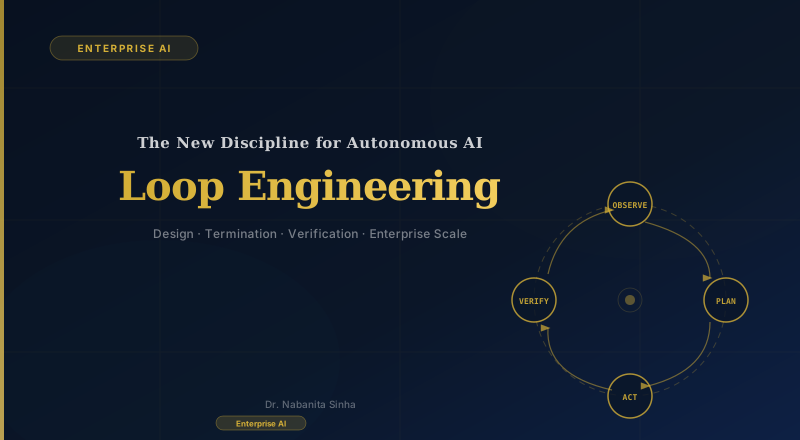
Repeating means the agent does not run once and hand off. It returns to the start of the cycle with updated information. Cycles means each iteration follows the same structure — observe, plan, act, verify — even if the content of each step changes. Stop condition is the hardest part: a concrete, testable criterion that signals the loop can exit safely.
Without a well-defined stop condition, a loop is just an agent in an infinite while-true. The model will keep running, consuming tokens, and producing output that no one reviews, until a timeout kills it or a bill arrives.
The skeleton every production loop follows
context = build_initial_context(task, memory, tools)
iteration = 0

while iteration < MAX_ITERATIONS:
    action = llm.decide(context)          # Observe + Plan
    result = tools.execute(action)        # Act
    context = context.update(result)      # Remember

    if verifier.passed(context):          # Verify
        break                             # Clean exit

    iteration += 1

log_trace(context)                        # Always log everything
output = summarise(context)
Four Types of Loops
Not all loops are the same. The right type depends on what triggers the work and what constitutes done.
Turn-Based Loop
Triggered by
A user prompt
Stop condition
Agent judges the task is complete or needs more context
Enterprise use
Suitable for internal helpdesks and single-query analytical workflows.
Goal-Based Loop
Triggered by
A defined objective with measurable success criteria
Stop condition
The agent's output passes a verifier — a test suite, a scoring function, or an LLM judge
Enterprise use
The backbone of agentic QA, compliance-check, and report-generation pipelines.
Time-Based Loop
Triggered by
A schedule — cron, interval, or deadline
Stop condition
The scheduled window closes or the task completes
Enterprise use
Replaces brittle cron scripts with an agent that adapts its approach each run.
Proactive Loop
Triggered by
An external event — a webhook, a file upload, an alert threshold breached
Stop condition
The triggered workflow resolves or escalates to a human
Enterprise use
The pattern that turns AI from a chatbot into an operational system.
The Four-Level Loop Stack
LangChain's loop engineering framework describes how loops nest inside each other — each level adding a new quality guarantee to the level below it. More capable agents stack more levels; each level adds cost and complexity, so you only add what the task demands.
The Agent Loop
The foundational cycle: the LLM receives context, decides on a tool call, executes it, observes the result, and repeats until it believes the task is done.
while not done:
  action = llm.decide(context)
  result = tools.execute(action)
  context.append(result)
  done = llm.check_done(context)
Watch out for
Infinite loops if the termination check is weak. Token cost spirals as context grows.
Verification Loop
A second agent — or an automated test suite — reviews the output of Level 1 and sends it back if it fails. The agent iterates until the verifier passes or a retry limit is hit.
output = agent.run(task)
for attempt in range(MAX_RETRIES):
  result = verifier.check(output)
  if result.passed: break
  output = agent.revise(output, result.feedback)
Watch out for
Verifier must be stricter than the generator. If both are LLMs, they can agree on a wrong answer.
Event-Driven Loop
The agent subscribes to a stream of real-world events and runs a mini-loop for each. Used for monitoring, alerting, and continuous process automation.
for event in event_stream:
  context = build_context(event)
  response = agent.run(context)
  if response.needs_human:
    escalate(response)
  else:
    apply(response)
Watch out for
Volume spikes can overwhelm the agent. Rate limiting and priority queues are mandatory.
Hill-Climbing Loop
The agent runs multiple candidate solutions in parallel, scores them, picks the best, and iterates — a search strategy rather than a straight execution path.
candidates = [agent.run(task) for _ in range(N)]
best = max(candidates, key=scorer.score)
for round in range(ROUNDS):
  candidates = agent.refine(best, N)
  best = max(candidates, key=scorer.score)
Watch out for
Expensive. Use only when quality is the bottleneck and cost is not the constraint.
Practical rule: Start at Level 1. Add Level 2 (verification) for any task where wrong output has real consequences — compliance reports, financial summaries, code that goes to production. Add Levels 3 and 4 only when the task is high-volume or high-stakes enough to justify the cost. Most enterprise workflows live at Levels 1–2.
The Three Hardest Problems
Every loop engineering failure in production traces back to one of three root causes. Get any one of them wrong and the loop either halts too early, runs forever, or produces output that looks correct but isn't.
Context Management
The problem
Every loop iteration appends observations to the context window. Long-running loops exhaust the token budget — the model starts losing early decisions and repeating work it already did.
The fix
Summarise completed steps into a compact memory block. Keep only the current step's raw detail. Use a structured scratchpad — not the full transcript — as the agent's working memory.
Termination
The problem
An agent that cannot reliably decide when it is done will either quit too early (partial output) or run forever (infinite loop, cost explosion). Leaving this to the model's judgement is not a strategy.
The fix
Define a hard stop condition before the loop starts: a test that passes, a word count reached, a tool call that returns a completion signal. Add a maximum iteration count as a circuit breaker. Log every exit.
Verification
The problem
The agent believes it has succeeded. You need to know whether it actually did. Without an independent check, successful-looking output can be confidently wrong — a dangerous property in regulated environments.
The fix
Treat verification as a separate layer, not a question you ask the same model that produced the output. Use deterministic checks where possible (unit tests, schema validation, rule-based scorers). Use LLM-as-judge only for qualities that cannot be tested programmatically.
Loop Engineering in Regulated Environments
Most loop engineering literature is written for software engineers building developer tools. Enterprise AI has a harder constraint set: regulated outputs, audit trail requirements, human-in-the-loop obligations for specific decision classes, and cost accountability at scale.
Three adjustments make the four-level stack enterprise-ready:
- Mandatory trace logging. Every loop iteration must write its context, action, tool result, and verification outcome to a persistent store — not just the final output. When a regulator asks why the system produced a particular answer, the loop trace is your evidence.
- Deterministic stop conditions for high-risk tasks. For tasks that affect money, health, or legal status, the stop condition cannot be "the model says it's done." It must be a deterministic check: a database row updated, a schema validated, a rule-based test passed. LLM-as-judge is acceptable only for text quality, not for factual correctness in high-stakes domains.
- Escalation paths, not just circuit breakers. When a loop hits its maximum iteration count without passing verification, it should not silently succeed or silently fail. It should route to a human queue with a full trace — the equivalent of a supervised fallback. Design this path before you need it.
Where to Start
Pick one existing workflow
Find a process your team runs manually on a schedule — a weekly report, a nightly data check, a recurring compliance scan. That is your first loop candidate.
Define the stop condition first
Before writing any agent code, write the test that a good output must pass. If you cannot articulate the stop condition, the loop is not ready to be built.
Build Level 1, then Level 2
Start with a simple agent loop. Once it runs reliably, add a verification layer. Do not attempt Levels 3 or 4 until the first two are stable and instrumented.
Log everything
From day one, every iteration should write its trace. You will use these logs to debug failures, improve the loop, and answer questions you have not thought of yet.
Key Takeaways
- Loop engineering is the discipline of designing the system that runs, checks, and re-runs your agent — not writing the prompt itself.
- The four loop types (turn-based, goal-based, time-based, proactive) cover the full range of enterprise automation patterns.
- The four-level stack adds quality guarantees progressively: most enterprise workflows need Levels 1–2 only.
- Context management, termination, and verification are the three failure modes that account for almost every production loop breakdown.
- Regulated environments require deterministic stop conditions, mandatory trace logging, and human escalation paths — not optional extras.